
Most cardiologists who look into locum tenens are happy with their chosen profession. They love what they do but are trying to get more control over how they practice. In this guide, you’ll learn how locum tenens works for cardiology specifically:
- Why cardiologists are choosing locums
- What types of assignments are available
- How pay for locum cardiologists works
- What the tradeoffs of working locums are
What is locum tenens for a cardiologist?
“Locum tenens” is Latin for “to hold the place of.” In healthcare, it means a physician temporarily works in place of—or alongside—a permanent physician.
A hospital or practice might bring in a locum cardiologist for many different reasons: a physician is on leave, the group is between permanent hires, patient volume has outgrown current staffing, or the organization is struggling to recruit in a particular market. Cardiology sees more of this than most specialties: nearly half of U.S. counties don’t have a practicing cardiologist at all, and those coverage gaps don’t close themselves.
Locum cardiology assignments can run anywhere from a few days to several months or longer. You can take one and stop, work periodically throughout the year, or make locums your primary way of practicing. It doesn’t have to be all-or-nothing.
Why are cardiologists choosing locum tenens?
Cardiologists choose locum tenens for a mix of reasons. A fellow finishing training might use locums to try out different practice environments before settling into a permanent job. A mid-career cardiologist might want supplemental income or a break from a demanding practice. A physician closer to retirement might want to keep practicing, just on their own terms.
Here’s what tends to come up when cardiologists explain why they made the move.
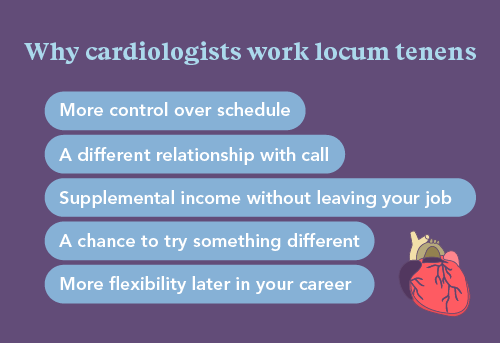
- More control over your schedule. Instead of accepting whatever schedule comes with a permanent position, you can look for assignments that fit the amount of work you actually want to do. Dr. Mark Connolly, a cardiothoracic surgeon, says, “It’s a nice thing to have your own time,” he says. “You’re not on call all the time, so you can work with your family, your significant other, and figure out what days are good to work.”
- A different relationship with call. Call is one of the biggest quality-of-life factors in cardiology, especially for subspecialties with STEMI or procedural call. With locums, you can look specifically for assignments with a call structure—in-house vs. home call, callback frequency, how call is compensated—that you’re actually comfortable with, rather than accepting whatever comes with a permanent slot.
- Supplemental income without leaving your job. Some cardiologists pick up locum work alongside a permanent position, whether it’s a few weeks a year or picking up weekend coverage. More on how the pay actually compares below.
- A chance to try something different. Locums lets you experience a different hospital, patient population, or practice model without signing a permanent contract. After starting his first assignment, Dr. Connolly says, “It’s a new adventure: meeting new people, new organizations.”
- More flexibility later in your career. Instead of going straight from full-time practice to retirement, some physicians use locum work to gradually scale down. “Maybe it’s kind of that half step toward being retired,” says cardiothoracic surgeon Dr. Mark Pool, “but for me, I still want to operate. I still want to be decently busy.”
What types of cardiology locum assignments are available?
Cardiology locum assignments take a few different forms, depending on your training, subspecialty, and the specific role.
- General, inpatient, and outpatient cardiology cover the largest share of assignments; they involve a mix of consults, rounding, admissions, follow-up visits, and diagnostic testing, depending on the facility. Before accepting, ask about patient volume, APP support, and what overnight or call coverage looks like. Don’t assume an outpatient assignment is automatically the lighter option; ask about visit volume and documentation load too.
- Interventional cardiology assignments can look very different: cath lab coverage, STEMI call, PCI volume, or a mix of clinical and procedural work. Be specific about in-house vs. home call, expected procedure volume, transfer capability, and what privileges the facility requires.
- Electrophysiology assignments may involve device management, procedures, or outpatient care. Because EP privileges tend to be facility-specific, confirm the assignment’s expectations match your current privileges before you commit.
- Cardiothoracic and cardiovascular surgery assignments tend to involve a heavier procedural and call commitment: CABG, valve repair or replacement, and aortic cases are common, sometimes alongside general thoracic work depending on the facility. Ask about case volume and complexity, whether call is in-house or home, and how OR block time is structured. Confirm postoperative coverage too: who’s managing the ICU and stepdown patients, and what assist support (PA, NP, or resident) you’ll have. If the role includes newer techniques like TAVR or robotic-assisted procedures, make sure your privileges and the facility’s credentialing requirements line up before you accept.
What does a typical cardiology locums schedule look like?
There isn’t one standard schedule; that’s one of the bigger differences from a permanent role. Depending on the assignment, you might see:
- Outpatient: A Monday–Friday clinic schedule
- Inpatient: 7-on/7-off or similar rotating blocks
- Short-term coverage: A handful of consecutive days
- Part-time: Roughly one week per month
- Weekend coverage: Friday–Sunday
- Procedural: Scheduled cath or EP blocks plus call
There’s no standard assignment length either; some run a few days or a long weekend, others run several months or longer, depending on the facility’s need and your own availability.
Don’t judge an assignment by the hourly rate alone. A higher rate can come with heavier call, more procedures, or longer days; a slightly lower rate attached to a schedule you actually enjoy can be the better deal.
How much do locum cardiologists get paid?
Rates vary by subspecialty, location, call structure, and how quickly a facility needs coverage. As a rough sense of scale, cardiology consistently ranks among the higher-paid locum specialties, and interventional, EP, and structural heart subspecialties tend to command more than general/noninvasive cardiology in permanent compensation surveys, a gap that carries over into locum rates as well. Here are some general pay ranges for the different subspecialties:
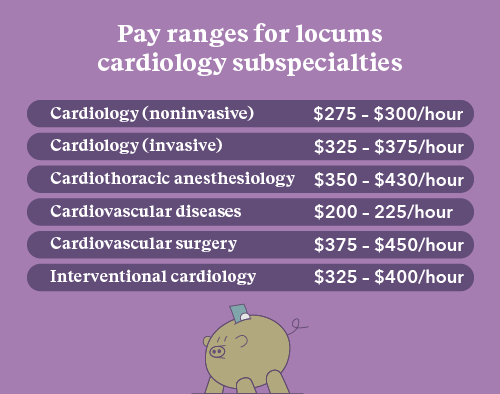
- Cardiology (noninvasive): $275-$300/hour
- Cardiology (invasive): $325-$375/hour
- Cardiothoracic anesthesiology: $350-$430/hour
- Cardiovascular diseases: $200-225/hour
- Cardiovascular surgery: $375-$450/hour
- Interventional cardiology: $325-$400/hour
Dr. Pool says, “I don’t make as much as I was making in total in Dallas, but I was underpaid compared to market rates there. Almost per hour worked, I make more now.”
What locums looks like for you: Locums pay & demand by specialty
Most locum work is structured as 1099 independent contractor income rather than W-2 employment, which changes how you handle taxes and retirement contributions.
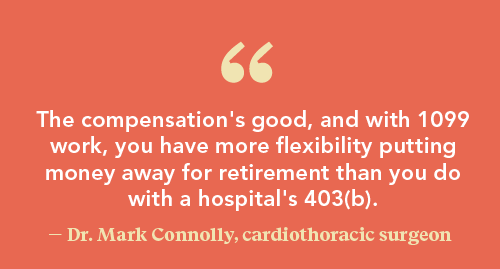
“The compensation’s good, and with 1099 work, you have more flexibility putting money away for retirement than you do with a hospital’s 403(b)” says Dr. Connolly.
Compare the two: 1099 vs. W-2 for locum physicians
How does licensing and credentialing work for cardiologists?
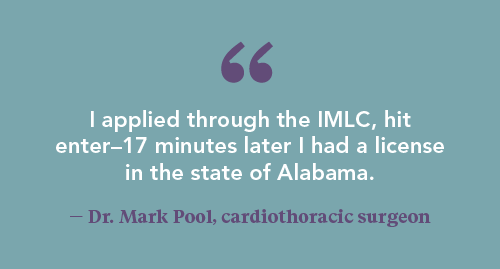
Licensing and credentialing work as two separate steps: you need a state license to practice in each state where you’ll provide care, and separate credentialing approval from the facility itself before you can actually start. If your home state participates in the Interstate Medical Licensure Compact (IMLC), getting licensed in additional states can move faster than most physicians expect. Dr. Mark Pool says, “I applied through the IMLC, hit enter and 17 minutes later I had a license in the state of Alabama.”
That distinction matters more in cardiology than in a lot of specialties. An interventional cardiologist, for example, may need to document procedural experience before a hospital grants specific privileges.
Get started: How physician licensing works for locums
What should I ask before accepting a cardiology locum assignment?
A few clusters of topics that are worth asking about before you say yes:
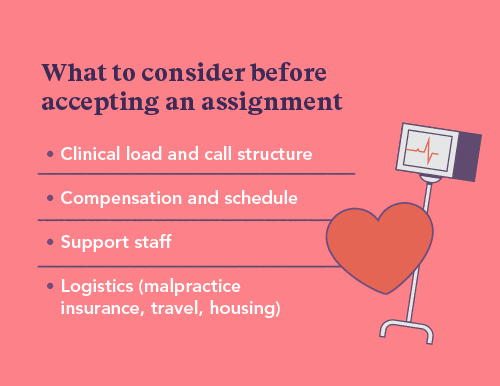
- Clinical load and call structure: Patient volume, procedure mix, who handles admissions, and exactly what call looks like (in-house vs. home, callback frequency, STEMI coverage if applicable).
- Compensation and schedule: Whether the rate is hourly or daily, how call and callbacks are paid, and how firm the dates are.
- Support staff and logistics: What nursing, APP, and imaging support you’ll actually have. This one matters more than it might seem: “There’s really a shortage across the country, particularly with cardiothoracic surgery PAs,” says Dr. Connolly. “It’s hard for organizations to find good, high-quality support.”
- Logistics: Who’s covering malpractice insurance, travel, and housing, and what happens if you’re bringing family along. Most agencies handle all of this but confirm the specifics before you sign anything.
The goal isn’t to interrogate the facility, it’s to make sure the assignment you agreed to is the one you actually show up to do.
What are the downsides of locum tenens for cardiologists?
Locum tenens comes with real tradeoffs alongside the flexibility.
- You have to adapt quickly. Every hospital has different systems, workflows, and personalities. You need to be comfortable walking into a new environment and figuring things out fast.
- Support levels vary. The nursing, APP, imaging, and cath lab support you’re used to at one facility may not exist at another.
- Assignments can end on short notice. Most arrangements allow either side to end things with about 30 days’ notice.
- Benefits look different. Depending on how you’re engaged, you may not have the employer-sponsored health insurance, retirement match, or PTO that comes with a permanent position. That’s worth weighing against the pay itself, not just comparing hourly rates.
Is locum tenens worth it for cardiologists?
It depends on what you’re looking for. If you’re happy with your current practice and value the predictability of a permanent role, locums may not be particularly appealing. But if you want more control over your schedule, additional income, or a chance to see how practicing somewhere else feels, it’s worth exploring, and you don’t have to decide it’s your long-term career before you try it once.

Cardiology locums FAQ
Is locum tenens good for cardiologists dealing with workload and burnout?
It can help if you are feeling burned out and overloaded. Locums puts you back in the driver’s seat: you can pick your schedule, skip the administrative duties, and work at a pace that is right for you. It can allow you to get out from under whatever is grinding you down without leaving the cardiology profession altogether.
What happens between assignments if I’m in a smaller subspecialty like EP, heart failure, or structural heart?
Plan further ahead than a general cardiologist might. The general/noninvasive job pool is larger and steadier; niche procedural subspecialties have fewer open assignments at any given time, so it helps to start your next search a couple of months before your current one ends.
Can I keep my permanent job and do locums?
Yes, you can keep your permanent job and still do locums. This is one of the more common ways physicians try locums without making a major career change. Some cardiologists use temporary assignments to earn extra income, try a different practice environment, or test out a potential relocation.
Before you do, review your current employment agreement. Some contracts restrict moonlighting, outside employment, or work with competing practices.
Can I do locums right out of fellowship?
Potentially, yes. Locums isn’t just for physicians who’ve been practicing for decades. What’s available to you will depend on your training, board certification or eligibility, and the clinical experience the assignment requires. If you’re coming straight out of fellowship, be upfront with your recruiter about your experience and the patients and procedures you’re comfortable managing.