Certified registered nurse anesthetists (CRNAs) have more flexibility in how they structure a career than a lot of people realize. Locum tenens is one of the more common ways CRNAs use that flexibility, whether they are looking for a different schedule, want to try a new practice setting, need extra income, or some combination of all three.
Here’s what you’ll learn in this guide:
- What does locum tenens look like for a CRNA?
- How does locum tenens works for CRNAs?
- Why do CRNAs choose to do locums?
- What is the demand for CRNAs?
- How do you know if locum tenens is right for you?
What is locum tenens for a nurse anesthetist (CRNA)?
“Locum tenens” is Latin for “to hold the place of.” For a CRNA, that means temporarily providing anesthesia care at a hospital, ambulatory surgery center, or pain clinic that has a coverage gap: someone’s on leave, a position is vacant, or the facility just needs extra hands during a busy stretch.
Locum CRNAs cover the same ground employed CRNAs do: general surgery, obstetric, and pain management cases, call coverage, and everything in between. What changes from location to location is scope of practice, which still depends on the state. For example, in states that have opted out of the federal physician-supervision requirement, a locum CRNA can practice to the full extent of their training; in states that haven’t opted out, supervision requirements apply no matter how experienced you are. Worth confirming before you accept an assignment.
Assignments run anywhere from a few days to several months. And despite the image of a locums provider living out of a suitcase, plenty of CRNAs work locums close to home instead of traveling.
How locum tenens works for CRNAs
Most CRNAs who work locum tenens do it through a staffing agency rather than negotiating assignments on their own. An agency handles credentialing paperwork, provides malpractice coverage, and takes care of the back-and-forth of matching you to an assignment that fits your specialty, timing, and location preferences.
Local locums vs. travel assignments
Many CRNAs pick up “local locums” work close to home instead of traveling cross-country. This might be a couple of shifts a month, or a short assignment an hour or two away, rather than a move to another state.
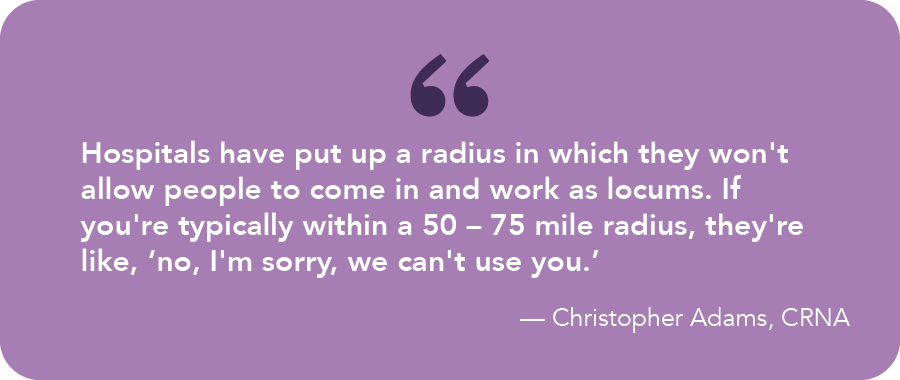
One caution worth knowing before you start: some facilities restrict hiring locums who live within a set radius, often citing non-compete-adjacent policies. It’s a genuinely frustrating wrinkle for CRNAs who’d otherwise want to pick up local work. Christopher Adams, a locum tenens CRNA, says, “Practices, hospitals have basically put up a kind of a radius in which they won’t allow people to come in and work as locums. If you’re typically within a 50-75 mile radius, they’re like, no, I’m sorry, we can’t use you.”
Worth asking about upfront if working close to home is part of your plan.
Why CRNAs choose locum tenens
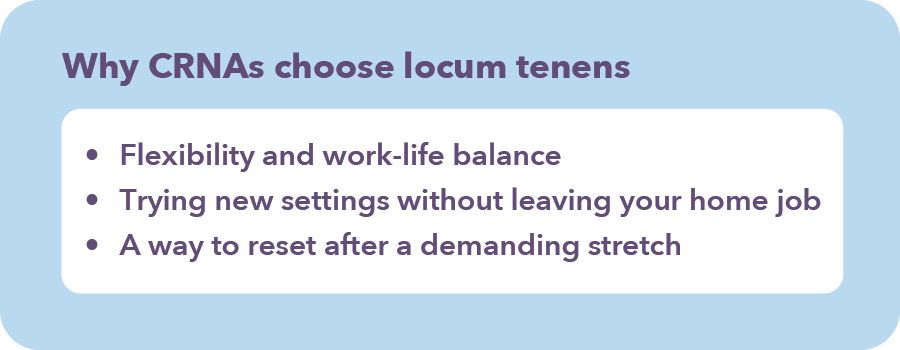
1. Flexibility and work-life balance
Christopher Adams, a CRNA based in Johnson City, Tennessee, built his own version of this: a local, W-2 anchor role, with locum or per diem shifts filled in around it. For him, that hybrid setup works like a release valve. He earns extra income and gets the variety without giving up the stability of a home position.
2. Trying new settings without leaving your home job
A 2025 study by CHG Healthcare found that 54% of CRNAs surveyed have worked locum tenens at some point, and many of them keep a traditional role alongside it rather than leaving it behind entirely. That’s worth considering if locums still feels like an all-or-nothing decision to you—for many CRNAs that isn’t the case.
3. A way to reset after a demanding stretch
Adams’ own career illustrates this well: he started in a busy trauma center, moved into a chief CRNA role, and later, deliberately, shifted toward more routine, lower-acuity cases instead of the high-intensity trauma work he’d built his career on. Locum tenens gave him a way to make that shift on his own terms rather than staying on a track that no longer fit well.
What is the demand for locum CRNAs?
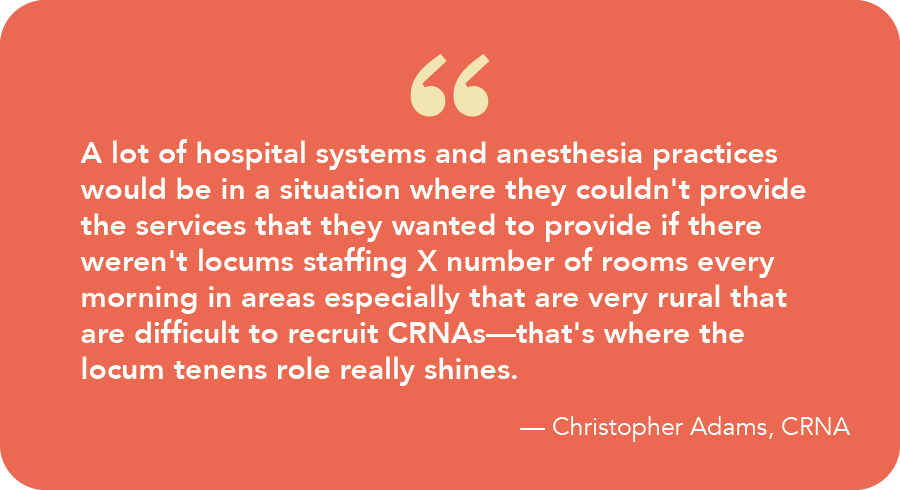
- CRNAs make up more than 80% of anesthesia providers in rural counties, and the anesthesiology workforce could face a shortage of roughly 12,500 providers by 2033, about 22% of the current workforce, concentrated hardest in rural communities. That gap is where locum tenens CRNAs fill a real, ongoing need.
- CRNA jobs are the fastest growing segment of locum tenens market according to Locumsmart,a locum tenens vendor-management platform: CRNA demand has grown every year for at least the past four years, and in 2025, nearly 20% of all shifts added to Locumsmart were for CRNAs, representing $180.9M in specialty spend, concentrated in low-density, rural, and cold-climate states.
Tips for choosing a locum tenens agency and recruiter as a CRNA
Look for agency experience specifically with CRNAs, not just physicians generally. CRNA-specific expertise is the single factor CRNAs weigh most heavily when picking an agency, ahead of compensation itself.
Adams’ experience is a good illustration of what strong agency support looks like day to day: his agency’s travel department books flights, cars, and lodging end-to-end, and he can call a 24/7 support line whenever something comes up. He’s also built a long-standing relationship with his recruiter, who knows his preferences well enough to bring him assignments that are a good fit.
Clear communication and transparencymatter as much as logistics. Before you sign anything, you should have a plain, upfront understanding of pay, malpractice coverage, and what the agency handles versus what’s on you.
Keep in mind that dozens of agencies work with CRNAs, and it’s worth comparing more than one.
Getting started as a locum tenens CRNA
If you’re a new grad or early in your career
Adams’ advice: build a base of independent, higher-acuity experience first. Agencies and facilities generally expect a locum CRNA to handle most situations competently from day one, without much on-site ramp-up—that’s a different bar than a first staff job, where you’re easing in with more support around you.
If you’re mid- or late-career and not ready to leave your home system
Try “local locums” on a small scale first. Use a week or two of existing PTO to work an assignment a couple of hours from home before committing to anything bigger. It’s a low-risk way to see how locums actually fits your life before you make a bigger decision.
Beyond that, the basics are the same for every CRNA considering locums: get clear on your “why,” check your state licensing situation, confirm malpractice coverage applies to the specific assignment, and decide whether you’ll work with an agency or search independently.
Is locum tenens right for you?
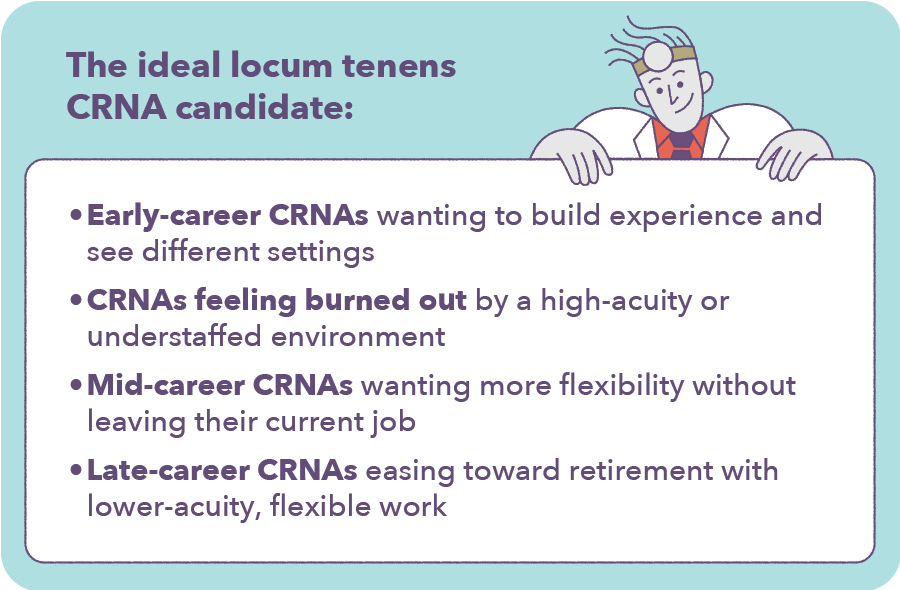
Locum tenens tends to fit certain CRNAs particularly well:
- Early-career CRNAs wanting to build experience and see different settings
- CRNAs feeling burned out by a high-acuity or understaffed environment
- Mid-career CRNAs wanting more flexibility without leaving their current job
- Late-career CRNAs easing toward retirement with lower-acuity, flexible work
Locum tenens may not be as good a fit for providers with young children, or a partner whose job can’t flex around travel or an unpredictable schedule, often find the tradeoffs harder to make work.
FAQ
Why do CRNAs choose locum tenens?
Mainly for flexibility, the chance to try new clinical settings, and a way to reset after a demanding stretch, often alongside a home position rather than instead of one.
Is locum tenens right for CRNAs?
It fits many CRNAs, from new grads building experience to late-career CRNAs easing toward retirement. It tends to be a harder fit for CRNAs with young children or a partner whose work can’t flex around travel.
How do I choose a locum tenens agency as a CRNA?
Prioritize agencies with real CRNA-specific experience, ask about malpractice coverage and support logistics upfront, and compare more than one option before committing.
What questions should I ask before accepting a CRNA locum tenens assignment?
Confirm pay structure, malpractice coverage type, credentialing timeline, and any facility-specific restrictions, like local-hire radius rules.
What are the requirements for CRNA locum tenens work?
An active, unencumbered CRNA license (in the assignment’s state, or in progress via reciprocity), current certifications, and malpractice coverage—either agency-provided or your own.
How does CRNA credentialing work for locum tenens?
Facilities verify your license, certifications, and work history before granting privileges. Timelines vary by state and facility.
How does housing and travel work for locum CRNAs?
For travel assignments, agencies typically arrange or reimburse housing and travel. Local locums assignments usually don’t involve either, since you’re working close to home.
What are the benefits of locum tenens for CRNAs?
Flexibility, exposure to new clinical settings, and often higher per-shift pay than an equivalent employed role—balanced against less predictability and, for 1099 work, more responsibility for your own taxes and benefits.