
This article isn’t personalized tax, legal, or financial advice. Talk with a qualified tax professional about your specific situation before making any decisions.
CRNA scheduling already looks different from that of many other clinical roles—block shifts, 24-hour call, weeks on and weeks off—which is part of why locum tenens work tends to fit naturally into a CRNA’s career. With anesthesia coverage stretched thin in many facilities, especially in rural areas, 1099 locum tenens is a great way to supplement your income and has become a normal part of how many CRNAs choose to practice.
Whether you’ve already got a 1099 offer in hand or you’re just starting to wonder what it would mean to go independent, it helps to know what a 1099 contract involves. In this guide, you’ll learn what actually changes so that you can weigh it for yourself:
- What 1099 means for a CRNA
- What a locum contract looks like
- Malpractice coverage
- Taxes: What changes as a 1099 CRNA
- How CRNA 1099 pay works
- CRNA credentialing timelines
- Working with a staffing agency as a 1099 CRNA
- 1099 FAQs
New to locum tenens as a CRNA? Start with our CRNA locums 101
What does 1099 mean for a CRNA independent contractor?
When you take a 1099 assignment, you’re classified as an independent contractor, not an employee. Your hiring facility usually makes classification based on IRS rules and how the assignment is structured.
For CRNAs, that question looks a little different than it does for the rest of the locum tenens world. Travel PAs and NPs are usually W-2. Physician locum tenens is typically 1099. CRNA locums can be either. It’s important to know how both work because your pay structure, benefits, and tax treatment shift depending on which one you land in, so it’s worth confirming up front rather than assuming.
Christopher Adams, a CRNA based in Johnson City, Tennessee, has lived both models at once. After stepping back from a chief CRNA role, trying a locums assignment, and eventually going independent full time, he’s landed on a hybrid setup: a W-2 position at a local hospital, plus 1099 locums and per diem shifts on the side.
That hybrid approach is common, and it’s exactly why this isn’t an all-or-nothing decision.
For the full: W-2 vs. 1099 guide for locum tenens professionals
What a locums CRNA contract looks like
A CRNA locums contract usually spells out the basics: assignment length, your day rate or hourly pay, whether housing and travel are covered, who’s providing your malpractice coverage, and how much notice either side needs to give to end the assignment early. It’s important to read all of it before you sign.
A detail that CRNAs often miss: Exclusion radius clauses
Some facility contracts specify an exclusion radius—often 50 to 75 miles, based on what’s showing up in job postings—within which they won’t bring in a locum CRNA, even if you live there and want the work. That’s wider than most actual employment non-competes, which tend to run closer to 20 miles.
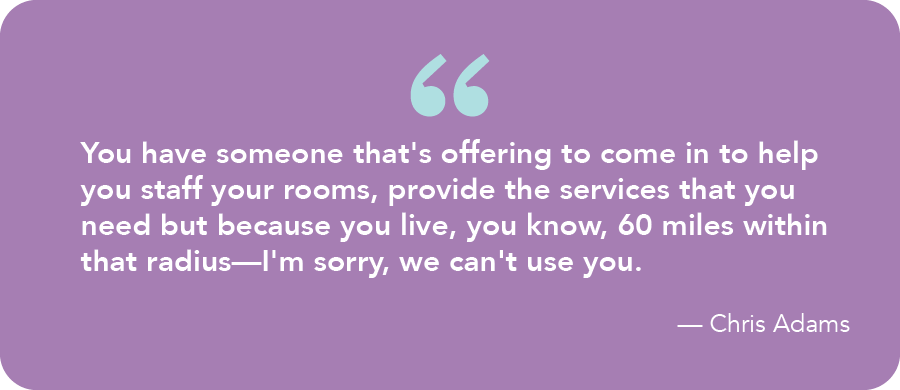
Christopher Adams has experienced this first-hand. “You have someone that’s offering to come in to help you staff your rooms, provide the services that you need,” he says, “but because you live, you know, 60 miles within that radius—I’m sorry, we can’t use you.”
It’s worth asking about this specifically before you sign, especially if you’re hoping to pick up “local locums” shifts close to home.
CRNA malpractice coverage: Occurrence vs. claims-made
Malpractice coverage generally comes in two types:
- Occurrence coverage protects you for anything that happens while the policy is active, no matter when the claim is filed.
- Claims-made coverage only protects you if both the incident and the claim happen while the policy is active. You can extend this window by purchasing “tail coverage.”
As an example, AANA Insurance Services, the CRNA professional association’s own affiliated insurer, recommends occurrence coverage over claims-made in most cases, though it notes the right choice depends on your individual situation. Standard coverage limits typically run $1 million per claim and $3 million per year. If an agency is providing your coverage, ask which type; and if you’re buying your own, factor this into the decision.
How your taxes change as a 1099 CRNA
The tax mechanics of 1099 work are the same for CRNAs as for any other 1099 locum tenens provider, and our physician’s guide to locum tenens taxes already covers the fundamentals in depth: the 15.3% self-employment tax rate, quarterly estimated payments, and the deductions available to you as a self-employed provider (travel, continuing education, licensing, equipment, home office, contributing to a retirement plan such as a Solo 401k or SEP-IRA, and more).
What’s worth spending more time on if you’re a CRNA specifically? Whether to form an LLC or elect S-corp tax treatment? Like most 1099 locum tenens providers, you’re a sole proprietor by default—no extra paperwork required to start deducting business expenses. An LLC or S-corp election can offer some separation of personal liability (different from malpractice protection) and, with an S-corp, potential self-employment tax savings. But both add real administrative complexity: payroll requirements, additional tax filings, and in most cases, the help of an accountant to manage it. It typically only makes sense once your 1099 income is high and consistent enough to justify that added cost.
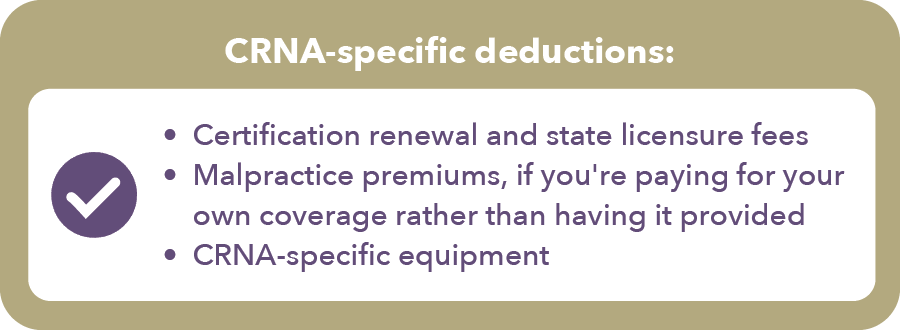
A few CRNA-specific deductions worth flagging on top of the general list:
- Certification renewal and state licensure fees
- Malpractice premiums, if you’re paying for your own coverage rather than having it provided
- CRNA-specific equipment
If your contract includes a housing stipend, pay attention to whether it’s structured as taxable income or an excludable reimbursement—that affects both your take-home pay and what you report.
How CRNA 1099 locum tenens pay works
CRNA locums pay is typically structured as a day rate or an hourly rate, and it generally runs higher than a comparable W-2 rate. As a 1099 provider, you’re covering your own benefits and 100% of your Social Security and Medicare tax (vs. you paying 50% and your employer paying 50% if W-2).
Ben Nanney CPA, CFP, owner of Locums Tax PLLC, recommends looking for at least 20% more than a comparable W-2 rate to make the math work in your favor; that benchmark comes from physician data, so treat it as a starting point for the conversation with your recruiter rather than a hard CRNA-specific rule.

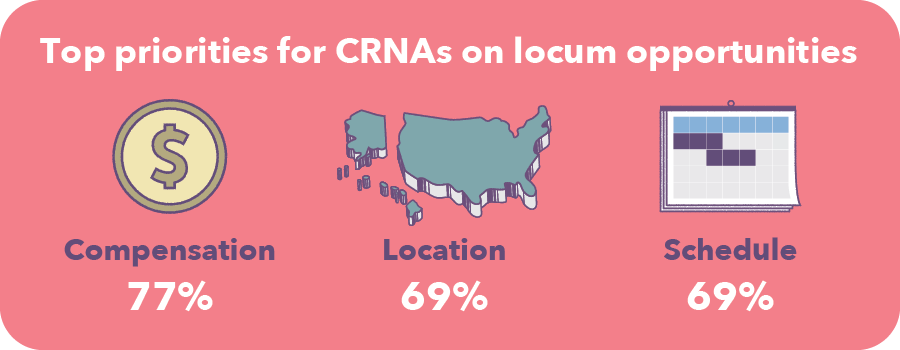
Pay is also the single biggest reason CRNAs give for choosing 1099 work in the first place. In a survey CHG Healthcare conducted on CRNA locum tenens work, 73% of CRNAs cited higher compensation potential as a reason to go independent, and when evaluating a specific opportunity, CRNAs ranked compensation (77%), location (69%), and schedule (69%) as their top priorities.
Pay varies by specialty, location, experience, and how tight the market is for CRNAs in a given area at a given time—ask your recruiter for real numbers for the assignment you’re actually considering.
CNRA credentialing timeline: What to expect
Before you can start a CRNA locums assignment, you’ll go through credentialing: primary source verification of your education and licensure, facility privileging, and—if you’re licensed in a new state—state licensure itself. None of this happens overnight, and it’s worth building the timeline into your planning rather than assuming you can start next week.
Credentialing timelines vary by state, specialty, and facility, so there’s no single number we can promise you—but having your documents ready ahead of time (current license, certifications, immunization records, CV, and references) is the biggest lever you have to speed things up.
Working with a staffing agency as a CRNA independent contractor
Going 1099 doesn’t mean handling everything yourself. A good staffing partner takes on a lot of the logistics: travel arrangements, credentialing support, help navigating malpractice coverage options, and a recruiter who knows your specialty.
According to CHG Healthcare’s findings on CRNAs, when CRNAs choose an agency, CRNA-specific expertise (75%) and compensation (71%) top the list of what matters most, ahead of brand name or convenience.
Locum tenens agencies like KREWE Anesthesia, a CRNA-founded and -led staffing company, can help you navigate some of the complexities of 1099 work.
Frequently asked questions
Is 1099 worth it for CRNAs?
For most CRNAs, yes: 62% prefer 1099 over W-2, and that rises to 86% among those with locum tenens experience. But “worth it” depends on your life stage and risk tolerance: 1099 work trades steady benefits and unemployment protection for higher pay and more control, so weigh both against where you are right now.
How does CRNA 1099 pay work?
CRNA 1099 pay is typically structured as a day rate or hourly rate, and it generally runs higher than a comparable W-2 rate to offset the cost of covering your own benefits and self-employment tax. Compensation is the single biggest factor CRNAs weigh when evaluating an opportunity, followed closely by location and schedule.
What taxes do 1099 CRNAs pay?
As a 1099 CRNA, you pay the standard self-employment tax rate of 15.3% on your net earnings, plus federal and state income tax, and you’re responsible for quarterly estimated payments since nothing is withheld automatically. There can also be business-specific taxes, such as Washington’s Business and Occupation Tax.
Should a CRNA form an LLC or S-corp?
Most 1099 CRNAs operate as sole proprietors by default (including an LLC taxed as a sole proprietor), and that’s fine for many. An LLC that elects S-corp taxation can offer potential tax savings, but this adds administrative complexity that typically only pays off once your 1099 income is high and consistent enough to justify it. Running an actual comparison between the sole proprietor and S-corp options based on your situation is the only accurate way to make this decision. If you aren’t able to run a comparison, choosing the simple sole proprietor route is likely the better choice.
Is CRNA malpractice insurance occurrence or claims-made?
Both types exist, but AANA Insurance Services—the CRNA professional association’s own affiliated insurer—says it recommends occurrence coverage over claims-made in most cases, while noting the right choice depends on your situation. Occurrence coverage protects you for anything that happened while the policy was active, regardless of when a claim is filed; claims-made requires both the incident and the claim to fall within the active policy period, or a purchased tail.
What’s the difference between CRNA W-2 and 1099 locum tenens work?
W-2 work comes with tax withholding and employer-provided benefits; 1099 work means no withholding, no employer-covered benefits, and more control over your schedule and pay. Our W-2 vs. 1099 guide covers the full comparison.