
Ben Nanney, CPA, CFP, owner of Locums Tax PLLC, explains retirement plan options for self-employed physicians. This is not intended as personalized financial advice. Please discuss your options with your financial advisor.
If you’re a self-employed locum tenens physician reading this who has set aside money for retirement but is unsure which account to use, smile and relax. You’ve done the hardest part!
For locum physicians, the primary retirement plan options are:
- Solo 401k
- SEP-IRA
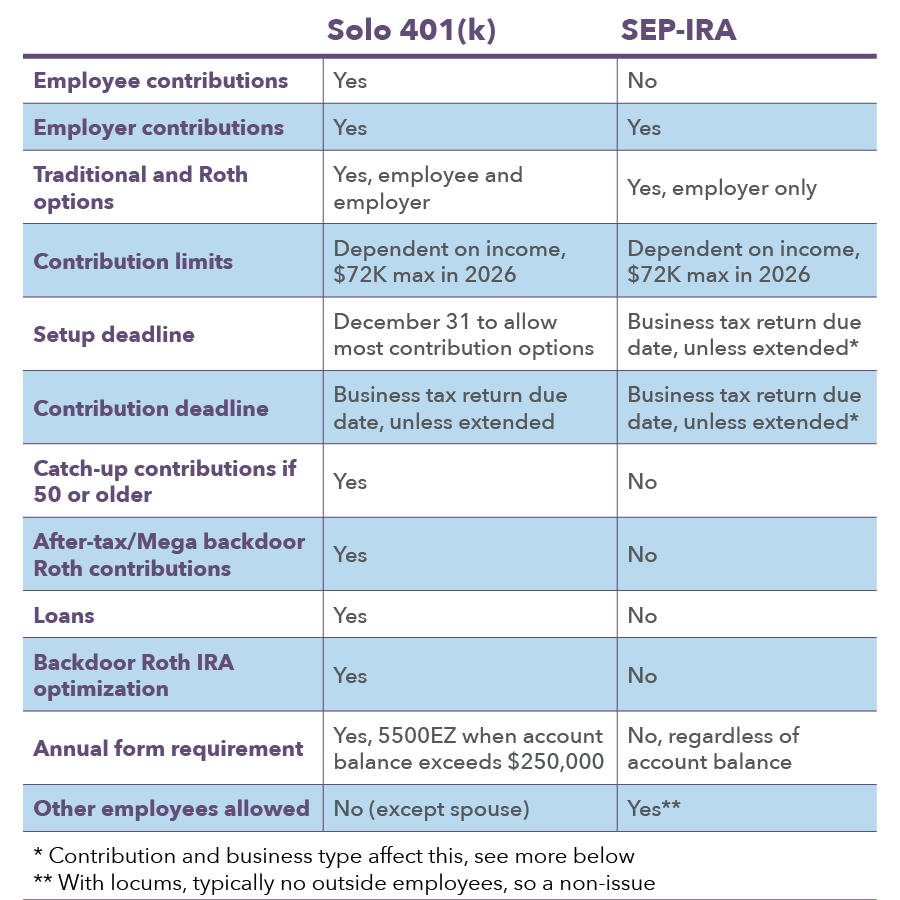
Both are solid options, but for reasons covered below, I recommend the solo 401(k) as the better option for most.
Solo 401(k) contribution types
Similar to a regular 401(k), a solo 401(k) has two contribution types:
- Employee: what you, as the business owner, can directly contribute
- Employer: what the business contributes on your behalf
With an SEP-IRA, there is only the employer contribution, not an employee contribution.
So why does this matter? Depending on business income, the solo 401(k) can allow for a larger total contribution than the SEP-IRA. We’ll see this in the next section.
Traditional vs. Roth contributions
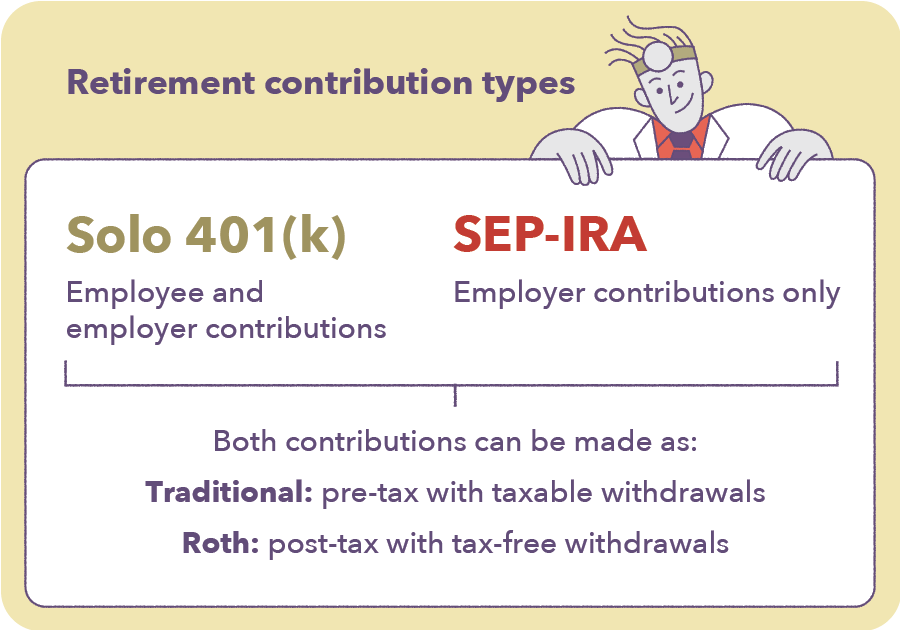
Both employee and employer contributions can be made as either:
- Traditional (pre-tax) with taxable withdrawals
- Roth (post-tax) with tax-free withdrawals
The Roth option is relatively new, most recently as an employer contribution, and does not seem to be used as often as traditional.
At the federal and most state levels, traditional contributions offer an immediate reduction in your tax owed, and any withdrawals in retirement are taxable. Conversely, Roth contributions offer no immediate tax reduction, while withdrawals in retirement are not taxable.
Retirement contribution limits for 2026
The max contribution allowable is based on three major items:
- Plan limit: $72,000 for 2026, without catch-up contributions
- Business type and income: sole proprietor or S-Corp
- Contributions to other 401(k) or 403(b) plans
The plan limit is the maximum amount that can be contributed to a solo 401(k) or SEP-IRA in a year. For 2026, the limit is $72,000. If over 50 years old, a solo 401(k) offers additional “catch-up” contributions of at least an additional $8,000 in 2026 that a SEP-IRA does not allow for.
Your business type (most commonly, either a sole proprietor or S-Corp) affects your contribution and can be a confusing piece of the contribution calculation.
Sole proprietor retirement contribution limits
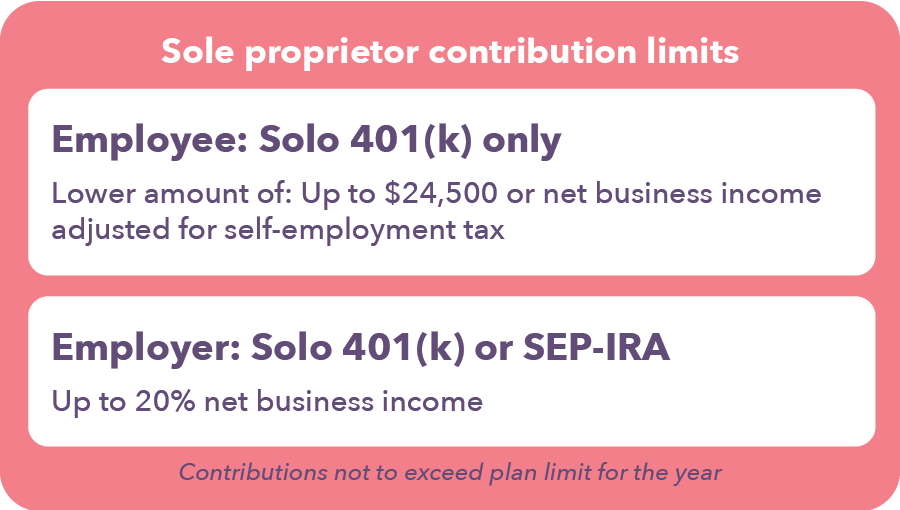
If a sole proprietor, the employee contribution for a solo 401(k)—there is no employee contribution for SEP-IRA—is the lower amount of:
- Up to $24,500
- Net business income with an adjustment for self-employment tax (Social Security and Medicare tax)
The employer contribution for a solo 401(k) or SEP-IRA is:
- Up to 20% of the net business income, with an adjustment for self-employment tax
The total employee and employer contributions can’t exceed the plan limit for the year ($72,000 in 2026, not including catch-up employee contributions)
As a best practice, because the maximum contribution as a sole proprietor depends on net business income reported on the tax return, it is best to wait to contribute the full/most of the amount until the tax return is complete. Otherwise, you can overcontribute, which can be a hassle to correct.
S-Corp retirement contribution limits
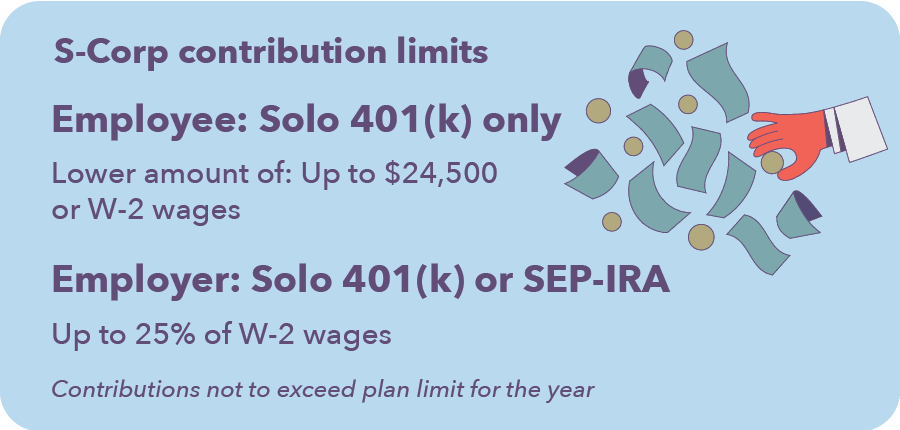
If you’re operating as an S-Corp, the calculation is more straightforward. The employee contribution for a solo 401(k) (no employee contribution for SEP-IRA) is the lower amount of:
- Up to $24,500
- W-2 wages you pay yourself as an owner-employee of the business.
The employer contribution for a solo 401k or SEP-IRA is:
- Up to 25% of the W-2 wages you pay to yourself as an owner-employee of the business
The total employee and employer contribution can’t exceed the plan limit for the year ($72,000 in 2026, not including catch-up employee contributions).
Whether a sole proprietor or an S-Corp, the max employee portion of the solo 401(k) contribution is affected if you’ve made other employee contributions to a 401(k) or 403(b) plan in that year. This mainly happens when you’re working a full-time W-2 job and have a separate business, such as locum tenens income, in the same year.
Locum tenens income: How pay works for locums
Sole proprietor example for 401(k) vs SEP-IRA
Here’s an example to illustrate: To keep things simple, we’ll assume you’re a sole proprietor who is less than 50 years old with $250,000 in 1099 income and $15,000 in expenses and doesn’t contribute to an outside 401(k) or 403(b) plan through another job. Here are the end results:
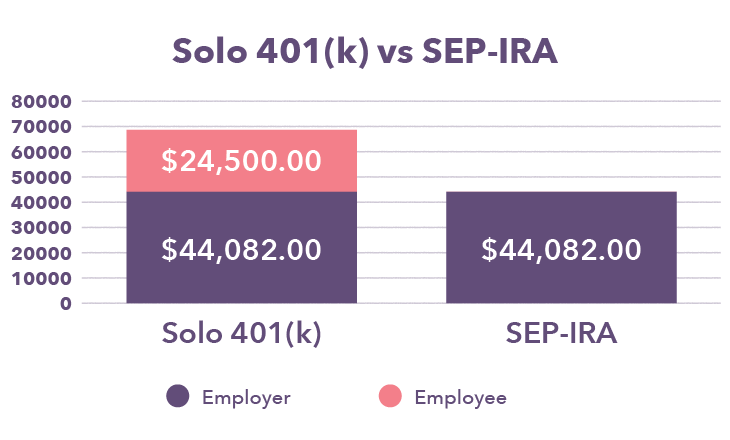
With a solo 401(k), you’re able to contribute up to $68,582 ($24,500 as employee contribution and $44,082 as employer contribution). With the SEP-IRA, you’re able to contribute up to $44,082 (only employer contribution allowed). In this example, the solo 401(k) provided a $24,500 contribution advantage with the employee portion.
Unless you’re over 50 years old, the solo 401(k) contribution advantage matters less once your income is high enough to allow the full $72K employer contribution.
Using the same example as above but with $450,000 in 1099 income (vs. $250,000) produces these results:
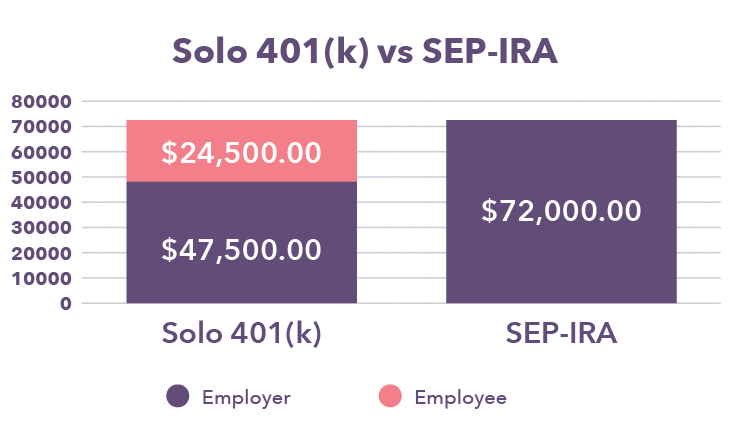
Here, the overall business income allows a potential employer contribution that hits the max $72K. So, with either the solo 401(k) or SEP-IRA, the total allowable contribution is the same.
If you’re a sole proprietor, this solo 401(k) contribution calculator can be helpful to consider different scenarios, although please do not use this as the final calculation you base your contribution on, as there can be other factors this calculator doesn’t account for. If working with an accountant, they can provide you with an accurate contribution amount based on the actual net business profit reported on your tax return for the year.
The solo 401(k) typically offers the largest potential contribution advantages when:
- The employer portion is less than the $72,000 plan limit for 2026, so that additional contributions can be made through the employee portion, or
- You, as the business owner, are at least 50 years old and want to take advantage of the additional catch-up employee contributions, which increases the $72,000 plan limit for 2026 by at least $8,000.
Deadline to open and contribute to a retirement fund
Deadlines to open and then contribute to a Solo 401(k) and SEP-IRA depend mainly on two things:
- Contribution type: employer or employee
- Business type- sole proprietor or S-Corp
First, the easy rule: For employer contribution with either a solo 401(k) or SEP-IRA, you can open and contribute as late as the extended return due date of the return, whether a sole proprietor or an S-Corp.
So, for the 2025 tax year ending December 31, 2025, if your return is extended (due date October 15 for a sole proprietor and September 15 for an S-Corp), then you can open and contribute the employer portion for either a solo 401(k) or SEP-IRA as late as the extended return due date.
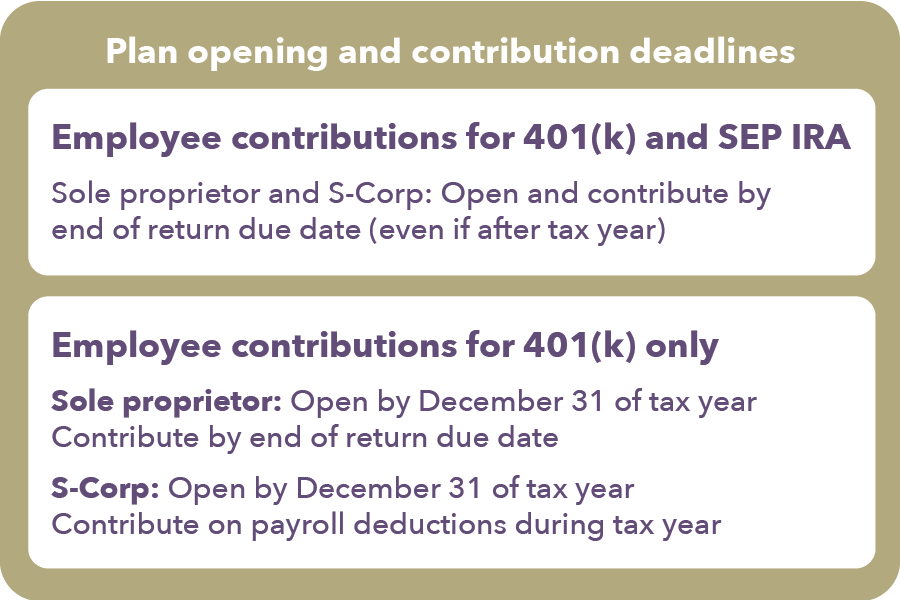
The employee contribution portion, which only the solo 401(k) allows for, has more restrictions. If a sole proprietor, the solo 401(k) would need to be opened by December 31 of the tax year to allow an employee contribution as late as the extended return due date of October 15.
So, for the 2025 tax year ending December 31, 2025, a solo 401(k) would need to be opened by December 31, 2025, to allow the employee contribution to be made for the 2025 tax year, as late as the extended October 15, 2026, due date.
If an S-Corp, the solo 401(k) would ideally be opened before December 31 so that you, as the owner and W-2 employee, could make an employee contribution through a payroll deduction on a paycheck dated in that year.
So, for the 2025 tax year ending December 31, 2025, a solo 401(k) would need to be opened and the employee portion deducted from your payroll check dated in 2025.
Bottom line? Both solo 401(k) and SEP-IRA can be opened and contributed to after the tax year is over for the employer side. For the employee side of the solo 401(k) contribution, the account at least needs to be opened by December 31 of that tax year if a sole proprietor, and ideally earlier if an S-Corp, to incorporate payroll withholding, to maximize contribution options.
Locum tenens pay trends: What specialties are up or down?
Advanced options for retirement plans
A solo 401(k) can also offer a few additional options that a SEP-IRA can’t, and they include:
- Mega backdoor Roth contribution
- Loans
- Backdoor Roth IRA contribution optimization
Mega backdoor Roth contributions
The mega backdoor Roth is named after the regular backdoor Roth IRA and is “mega” because it can allow much larger after-tax contributions than the regular backdoor Roth IRA. To do this, the solo 401(k) allows “after-tax contributions” (also known as non-deductible contributions), which can then be converted into a Roth account.
This option can make the most sense when your business income isn’t high enough to hit the max plan limit of $72,000 in 2026, but you still have an additional contribution you’d like to make.
Mega backdoor Roth contributions example
As an example, we’ll assume that you’re a sole proprietor who is less than 50 years old with $150,000 in 1099 income and $15,000 in expenses and don’t contribute to an outside 401(k) or 403(b) plan through another job. Here are the end results:
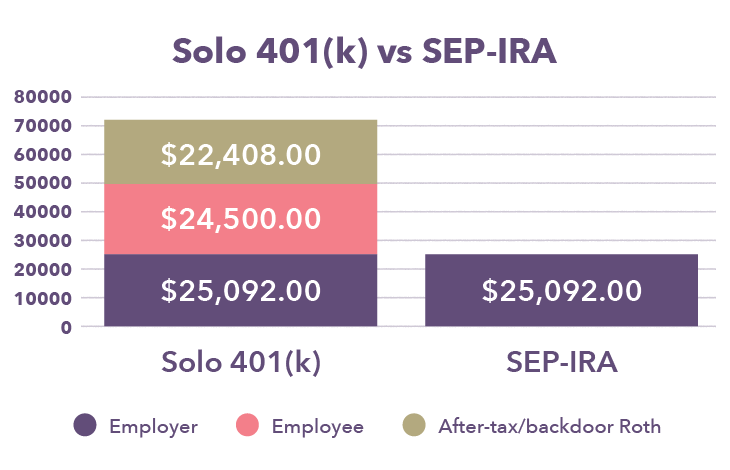
Using the mega-backdoor Roth strategy, you could make a total of $72,000 in contributions, even though your business income only allowed for employee and employer contributions that totaled $49,592 ($24,500 for employee and $25,092 for employer). The additional $22,408 contribution could be made as an after-tax contribution and then immediately converted “in-service” within the solo 401(k) to a Roth account, i.e., the mega backdoor Roth contribution.
There are a few moving pieces to this, and not all solo 401(k) plan providers offer this option due to the additional administrative work on their end. Usually, you’ll need to work with a more specialized plan provider, but it can be worth the effort if this is an option you’re interested in.
Loan withdrawals
Another option with a solo 401(k) plan is the ability to withdraw money from your solo 401(k) account as a formal loan and pay your solo 401(k) account back with interest over set payment terms. I am not a big encourager of borrowing from your retirement plan, especially since those funds can be abused, but it is an option to be aware of. As with the mega backdoor Roth, the loan option requires additional administrative services, so not all companies offer this and usually require a more specialized provider.
Backdoor IRA tax benefit
The backdoor Roth IRA is not directly part of either the solo 401(k) or SEP-IRA, but it is affected by the choice of the solo 401(k) or SEP-IRA. This is a separate strategy for contributing to a Roth IRA when your income is too high to make direct contributions. A solo 401(k) works well with this strategy, but a SEP-IRA will create additional tax under the pro rata rule.
Administrative burden of solo 401(k) and SEP-IRA accounts
For either a solo 401(k) or a SEP-IRA account, you will need to fill out standard forms to set them up, but maintenance will be minimal. While the paperwork itself is somewhat different between a solo 401(k) or SEP-IRA, the process is very similar.
Long-term, an annual information form may be required with a solo 401(k) account, which is not required with a SEP-IRA. After your solo 401(k) balance exceeds $250,000 at the end of the plan year (usually December 31), you’ll need to file a form with the IRS called Form 5500-EZ, which is typically due by July 31 of the following year. There isn’t any tax due with this form; it is only informational, but there can be penalties if it’s not filed. When needed, Form 5500EZ is usually filed either by your accountant or by the company you opened your solo 401(k) with. Both options typically charge a fee for this, likely around $150 – 300.
The SEP-IRA does have the advantage of simplicity here, as no annual filing is required, even after the account exceeds $250,000 at year-end.
Taxes and financial planning: Hear more advice from Ben Nanney (Apple podcast)
How to open either a Solo 401(k) or SEP-IRA
There are two basic options for opening one of these accounts:
- Through a financial advisor
- Directly with the provider
If you already have a financial advisor and have a good working relationship with them, I would start here. They can usually help you open either a solo 401(k) or a SEP-IRA.
As a potential benefit, your financial advisor can guide or manage the investments within the solo 401(k) or SEP-IRA account after contributions are made. This can be best if you’re looking for direct investment advice, need help integrating your solo 401(k) or SEP-IRA into your larger financial plan, and are willing to pay additional fees for this help.
The second option is to open the account directly with the provider. In this scenario, you’re taking the lead on completing the initial paperwork and deciding how to invest once the contributions are made. This is typically a better option if you’re not looking for much additional help, since you’ll incur lower fees in return for less service.
You’ll have many options when deciding on a plan provider. Vet these options to make the best choice for your situation, but options include Fidelity, Charles Schwab, and E*TRADE.
If you’re interested in mega backdoor Roth and loan options with a solo 401(k), you’ll likely need a more specialized company that offers these options. Vet these as well, but choices include Employee Fiduciary and My Solo 401(k) Financial. Expect to pay somewhat higher annual fees for premium options.
Solo 401(k) and SEP-IRA recap and recommendation
After considering all this, the solo 401(k) is my recommendation for most locum physicians. It offers additional benefits that the SEP-IRA doesn’t, including employee contributions, employee catch-up contributions, mega backdoor Roth contributions, loans, and backdoor Roth IRA optimization. The main drawback is the need to file the annual 5500EZ when the account value exceeds $250,000, but this isn’t overly complex and is worth the added benefits. Of note, solo 401(k) accounts don’t allow employees, other than your spouse, which is rarely an issue with a locum physician.
In the end, either is a solid option. Don’t let articles like this complicate things to the point of inaction. You can change from a solo 401(k) to a SEP-IRA and vice versa, so your choice isn’t set in stone. Pick an account, open the account, and then do the final step—contribute!