
If you’re a nurse practitioner considering locum tenens, you’ve probably heard that locums pays well. But how does that number actually get set, from your specialty and where you want to work, to whether you’re W-2 or 1099? Let’s break down the mechanics, starting with what determines how much a locum NP gets paid.
What determines a locum NP’s pay rate
Several moving parts build your rate as a locum:

- Specialty and acuity
- Scope of practice
- Location
- Patient volume
Two assignments in the same specialty can land at very different rates depending on how those factors line up, so it helps to understand how they’re weighted rather than memorizing a range.
Specialty and acuity
Specialty and acuity drive your rate as a locum NP more than almost anything else. Higher-acuity roles like cardiovascular/CVT surgery and neurosurgery pay more because more is riding on the decisions you’re making, because fewer NPs are qualified to do that work, and because the training and liability that come with it are higher, too. Locumstory’s specialty salary report puts higher-acuity specialties paying up to $140/hr, compared to $70 – $90/hr for primary and urgent care.
Additionally, clinician shortages, shifting patient volumes, and delayed permanent hiring all push more specialty coverage toward locums, and facilities pay accordingly, especially when they need someone fast.
See the salary range in your specialty: NP salary & demand report
Scope of practice and state licensure
For NPs, a unique factor that can influence your pay is the amount of autonomy you have on the job. This scope depends entirely on the state you’re licensed in, and that autonomy is directly tied to what you’re paid.
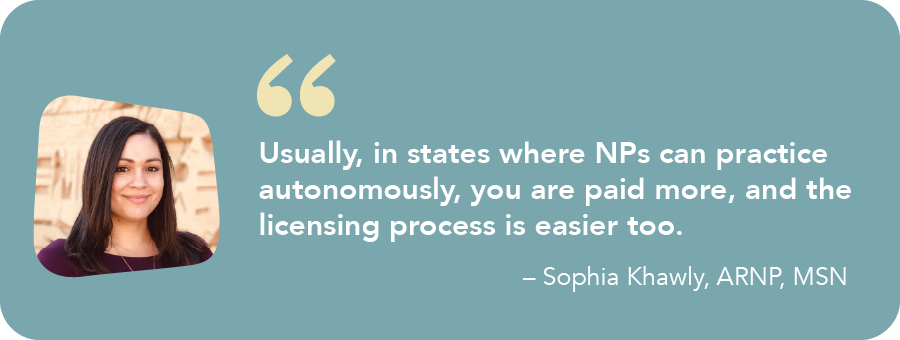
Sophia Khawly, a locum NP who’s worked assignments in more than a dozen states, has seen the difference firsthand. “Usually, in states where NPs can practice autonomously, you are paid more, and the licensing process is easier too,” she says. In full-practice-authority states like Washington, NPs can practice independently. In more restrictive states, like Georgia, you need a supervising physician on record.
Before you narrow your search to a specific state, consider practice authority. A smaller or less-competitive state that grants NPs full practice authority can be a better fit than a bigger, more popular market that still requires physician oversight.
Location and patient volume
Location plays into your rate as a locums NP in two ways. First, there’s demand: Rural and underserved areas often pay more simply because it’s harder to get anyone out there. “I like rural areas because they’re more laid back,” Sophia says, “and they tend to pay more too because they’re more in need of a provider.”
Second, a bigger number doesn’t always mean a better deal. Kelly Lueck, who’s worked locum NP assignments across the West, found that out by comparing two states side by side: “When I research California positions, they don’t pay any more than Arizona. And the cost of living there is way more than here.” Before you assume a bigger market means more take-home pay, weigh the rate against realistic costs of living. You may also have a higher patient volume in large metro areas than rural locations, which is why many NPs like Sophia enjoy working rural jobs more.
It’s tradeoffs more than a formula
Most locum NP assignments run three to four months, whether you’re covering a facility’s search for a permanent hire or filling a longer-term gap. Demand for locum NPs is currently high, and pay generally lands in the $65 – $115/hr range, though, as covered above, exactly where you fall depends on specialty, location, and scope.
Taken together, none of this adds up to a formula. It’s a set of tradeoffs you weigh against each other, and rate is one piece of that decision, not the whole thing.
W-2 vs. 1099, explained plainly
This is probably the one mechanic that can impact you the most, and it’s also where NPs most often get caught off guard.
Ebony Thyme came into locums from a W-2 travel-nursing background, where taxes get withheld automatically and benefits just come with the job. Her first year as a 1099 independent contractor, she didn’t realize how different that setup really was until tax season hit. “I took a major loss in my taxes my first year of being a locum,” she says. “$30,000, with no write-offs.” She’d also been mixing personal and business finances, which made the damage worse than it needed to be.
Benefits took a similar hit. When her employer-sponsored health insurance ended, Ebony turned to the marketplace and got flagged for making too much to qualify for the coverage she expected. “I didn’t know what to do about insurance,” she says. “I didn’t know anything about insurance.” At the time she chalked the confusion up to just being part of going independent. It wasn’t. It was a gap she could have planned around with the right information.
One thing that’s genuinely different for NPs versus physicians: most locum physicians work as 1099 contractors, full stop. Locum NPs often have another option. Many NP-focused agencies like CompHealth and Weatherby Healthcare hire NPs as W-2 employees specifically so health insurance and other benefits stay active for as long as you’re working an assignment with them. That structure would have solved Ebony’s exact problem, so it’s worth asking about directly before you sign anywhere.
For the full breakdown: W-2 vs. 1099 guide
What’s usually bundled into locum tenens pay for nurse practitioners

Beyond your base rate, most assignments bundle in some combination of housing, travel or a travel stipend, malpractice coverage, and credentialing support. What’s actually included varies by assignment and by agency, so get the specifics before you commit to anything.
Use our comparison tool: Compare locum tenens agencies
Credentialing is one of the pieces that can catch new locum NPs off guard, both in how long it takes and who’s responsible for it. “Most of the time, standardized credentialing is three months,” says Kelly Lueck. “But with the right agency, they can get you in within one to two weeks.” That’s the difference between waiting a season and starting next month, and how fast an agency moves on credentialing is a good preview of how they’ll handle everything else.
Patient volume deserves the same scrutiny as your hourly rate, because it’s really part of the same conversation. Sophia Khawley vets agencies specifically on whether they’ll hold a facility to what was agreed. She says she sticks with agencies that “will always take my side over the site” if a facility tries to push her patient load past what was negotiated. A higher rate doesn’t mean much if the workload behind it keeps growing.
Another factor to note is that pay is generally tied to hours actually worked. There’s typically no PTO between assignments unless you build that cushion in yourself, so plan for the gap now, rather than discovering it the hard way once you’re between contracts.
What are locum NPs actually making?

Locumstory’s own NP trends data puts pay in the $65 – $115/hr range overall. For the fuller picture, our NP specialty salary report breaks that down further: $70 – $90/hr in family practice, up to $100 – $140/hr in cardiovascular and CVT surgery, depending on demand and acuity.
Is pay really the top reason to work locums as an NP?
Compensation gets a lot of airtime in locum tenens conversations, enough that you’d expect it to be the deciding factor for most NPs. For a lot of providers, it isn’t.
“I learned that there’s no price for flexibility,” Sophia Khawley says. As a locum, she doesn’t have to work nights, doesn’t have to work holidays, and doesn’t have to take call unless she wants to. “There’s no amount of money they can pay me for an inflexible schedule.” Facilities have tried to bring her on permanently more than once. She’s turned all of them down.

That doesn’t mean pay is beside the point. Thomas Cotto puts it plainly: “You’re going to get great pay, but I think you really do have to have a really solid foundation as a nurse practitioner before you ever thought about doing it.” His point isn’t that pay doesn’t matter. It’s that the pay locums can offer assumes you’re walking in with enough clinical experience to handle the autonomy that comes with it.
What to ask before you sign a locum NP contract
Here’s a set of compensation-specific questions worth putting directly to your recruiter or agency before you accept an assignment:
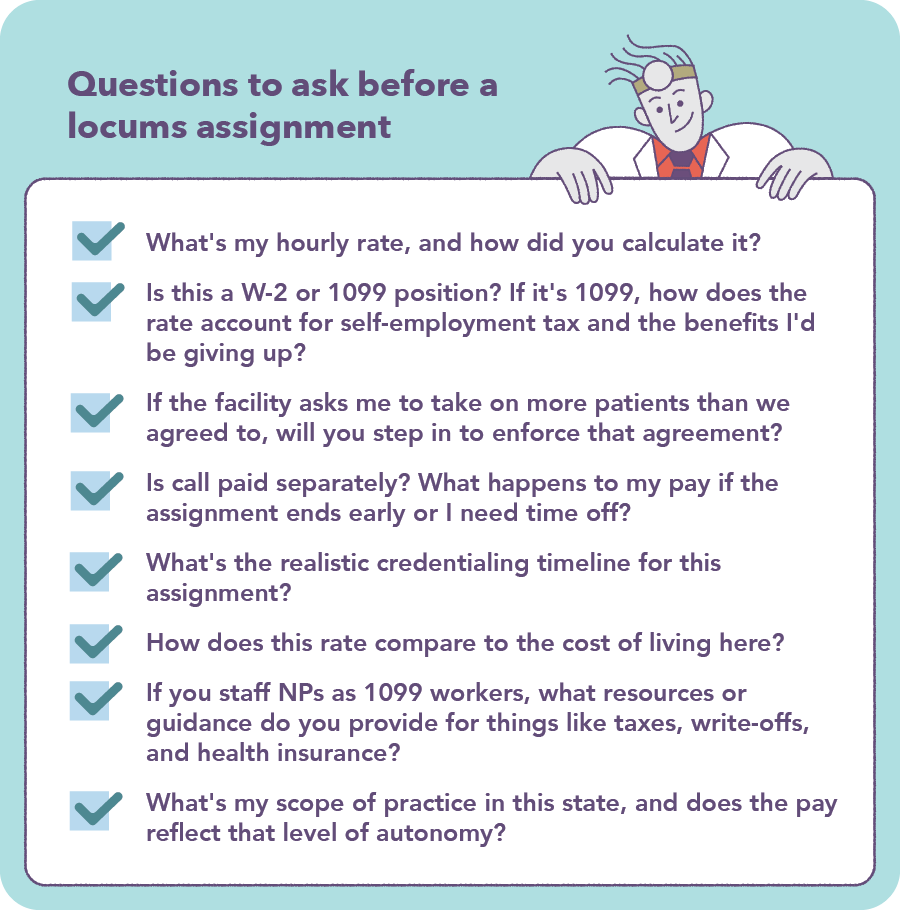
- What’s my hourly rate, and how did you calculate it, factoring in specialty, location, patient volume, and scope of practice?
- Is this a W-2 or 1099 position? If it’s 1099, how does the rate account for self-employment tax and the benefits I’d be giving up?
- If the facility asks me to take on more patients than we agreed to, will you step in to enforce that agreement?
- Is call paid separately? What happens to my pay if the assignment ends early or I need time off?
- What’s the realistic credentialing timeline for this assignment?
- How does this rate compare to the cost of living here? Is it actually a step up, or does it just look higher on paper?
- If you staff NPs as independent contractors, what resources or guidance do you provide for things like taxes, write-offs, and health insurance?
- What’s my scope of practice in this state, and does the pay reflect that level of autonomy?
If a recruiter can’t answer these clearly, that tells you something, too.
More on pay and locum tenens for NPs
If you want to hear more from the NPs quoted in this piece, in their own words, check out the full conversations on the Locumstory Podcast:
- Ebony Thyme on the W-2 vs. 1099 mistakes that cost her $30,000 (episode 1)
- Sophia Khawley on choosing flexibility over pay (episode 8)
- Kelly Lueck on agency partnership and credentialing timelines (episode 22)
- Thomas Cotto on building a foundation before you go locum (episode 71)
Ready to talk specifics? Compare locum tenens agencies to find one that fits how you want to work.