
Demand for locum tenens generally fluctuates because healthcare staffing constantly changes as facilities are adjusting to clinician shortages, shifting patient volumes, and financial pressures. Burnout and turnover create baseline demand for locum tenens NPs, while rural needs, seasonal surges, and sudden spikes in patient volume drive short-term increases. At the same time, budget constraints often delay permanent hires, leading to a greater reliance on temporary staffing, such as locum tenens.
Pay for locum tenens varies by assignment because compensation is driven less by standardized salaries and more by how difficult a role is to fill. Rates increase when facilities compete for a limited talent pool, particularly within the same region, and tend to be higher in rural or underserved areas where staffing is consistently harder to fill, especially at smaller or critical access hospitals. Specialty and the specifics of the job also play a major role: niche expertise or more demanding workloads typically come with a premium. Finally, urgency can significantly impact compensation, with last-minute or immediate-need assignments often offering higher rates to secure coverage quickly.
These variances create a meaningful opportunity for NPs interested in locum tenens: the ability to choose assignments based on both compensation and lifestyle (rather than defaulting to what’s available). Whether your goal is to maximize earnings, gain experience in new medical settings, build flexibility into your schedule, help where you’re needed most, or just try out a new place for the fun of it, the locum tenens market rewards NPs who understand how to position themselves within it.
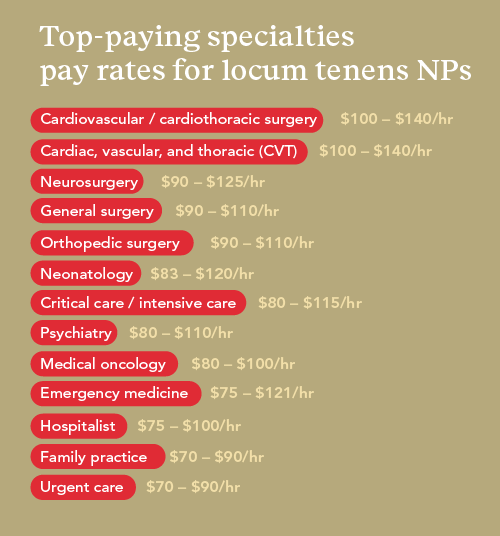
Top in-demand nurse practitioner specialties in 2026, and what they pay
*Note: The earnings ranges represent aggregated locum tenens market averages and are estimates, not guarantees.

Cardiovascular / cardiothoracic surgery: $100 – $140/hr
Demand for cardiovascular and cardiothoracic NPs is surging due to a critical “supply and demand” mismatch in heart care.
As experienced clinicians retire, the U.S. is projected to face a shortage of over 96,000 physicians by 2026, hitting procedure-intensive specialties like cardiology and surgery hard, where an estimated deficit of over 3,000 full-time roles is expected. At the same time, demand is growing. The aging population is driving up procedure volumes; for instance, coronary artery bypass grafting (CABG) is projected to account for 44% of the cardiac surgery market share in 2026 alone.
Because these roles require specialized procedural skills and intensive post-operative management, facilities rely on locum NPs to cover gaps in surgical teams and ensure 24/7 coverage for complex patient populations.

Critical care / intensive care: $80 – $115/hr
The need for critical care NPs is growing as inpatient acuity continues to rise across hospital settings. A 2024 study by the American College of Cardiology found that 86.2% of counties lack specialty heart and lung care in rural areas, thereby exacerbating staffing shortages. This limitation forces facilities to use locums to maintain ICU safety standards (and pay top dollar for the coverage).
Furthermore, with NP employment projected to grow 45% through 2032, hospitals and clinics of all sizes are increasingly utilizing locums as a long-term strategy to combat high burnout rates in intensive settings.
Emergency medicine: $75 – $121/hr
Last reviewed in June 2025, the CDC reports approximately 155 million emergency department visits annually in the U.S., with about 17.8 million resulting in hospital admission. The emergency room is a primary gateway to the hospital system, with around 12% of patient admissions originating there.
NPs can play a critical role on emergency medicine teams by managing patient flow, handling lower- to moderate acuity cases, supporting triage, and reducing bottlenecks.

Family practice: $70 – $90/hr
The Association of American Medical Colleges projects a shortage of 20,000 to 40,000 primary care physicians by 2036, and as of 2025, over 87% of NPs are already certified in primary care.
This happy overlap makes family practice NPs one of the most flexible resources for community clinics. Locum NPs give organizations a way to maintain access in both underserved and high-growth areas.
This specialty is on the lower end of the pay range, topping out around $90 per hour for locum tenens NPs.
Considering locums? Why one NP chooses locums
General surgery: $90 – $110/hr
With an aging surgeon workforce, where many specialists are over age 65, hospitals are facing immediate vacancies that threaten surgical throughput. “At the end of 2022, 25.6% of surgeons were older than 65 years. That percentage was even higher for the subspecialties of ophthalmology, orthopedics, plastic surgery, thoracic surgery, and urology,” says the 2026 SURGPLI Surgery Career report.
Locum NPs in general surgery are essential for maintaining the “first assist” pipeline and managing floor rounds. This, in turn, enables surgical departments to handle growth in surgical volume without delaying life-saving operations.

Hospitalist: $75 – $100/hr
U.S. hospitals see over 32 million inpatient admissions annually, with a significant portion involving patients with multiple chronic conditions requiring coordinated, high-touch care, per the Nationwide Readmissions Database (NRD) by the Agency for Healthcare Research and Quality. At the same time, the physician workforce is under strain: the Association of American Medical Colleges projects a shortage of up to 86,000 physicians by 2036, including hospital-based roles.
As a result, these facilities need to rely more on nurse practitioners to support hospitalist teams in managing admissions, rounding, and discharge planning to maintain throughput and continuity of care.

Medical oncology: $80 – $100/hr
Medical oncology is in high demand because of a “success paradox”: More people are surviving cancer, requiring long-term specialized management.
There were over 18.6 million cancer survivors in the U.S. by January 2025, and that number is rising. The American Cancer Society recently celebrated a milestone in cancer survival: 7 in 10 people reach the five-year mark.
This calls for locum tenens NPs to help clinics manage heavy infusion schedules and survivorship programs to ensure that the 70% five-year survival rate remains on an upward trajectory. The specialty generally commands locum tenens pay rates of $80 – $100 per hour.

Neonatology: $83 – $120/hr
Neonatal nurse practitioners (NNPs) represent only 1% to 2% of all advanced practice registered nurses (APRNs), yet they are responsible for the most vulnerable patients, those in neonatal intensive care units (NICUs). Each year, approximately 10% of U.S. births are born preterm (37 weeks or earlier) and often require intensive monitoring and intervention, according to the CDC. At the same time, NNP training programs produce a limited number of graduates annually, and the role requires highly specialized clinical experience that cannot be quickly scaled.
As such, NNPs are in a “critical shortage” state and are some of the most sought-after locum providers in 2026.

Neurosurgery: $90 – $125/hr
Neurosurgery is a high-intensity specialty, and the scarcity of providers creates significant locum tenens demand. Because neurosurgical procedures are technically demanding and carry high malpractice risks, hospitals and clinics must secure NPs who can manage complex spinal and cranial post-op care. To do so, they are willing to pay top-tier locum rates, up to $125 per hour.

Orthopedic surgery: $90 – $110/hr
Aging baby boomers and their need for joint replacements are leading to skyrocketing demand for NPs with an orthopedic specialty. Ortho Spine News reported that the global orthopedic implants market is expected to reach $52.86 billion in 2026, driven by a surge in hip, knee, and spinal procedures.
As orthopedic surgeons see a 4% projected growth in employment through 2034 per the BLS, facilities are increasingly relying on NPs to handle the high volume of perioperative care.

Psychiatry: $80 – $110/hr
Psychiatry is currently facing one of the most severe workforce deficits in healthcare. Over 122 million Americans live in Mental Health Professional Shortage Areas, per the American Association for Marriage and Family Therapy (AAMFT)’s 2025 Industry Workforce Study. The Bureau of Health Workforce’s findings are even bleaker, putting that figure closer to 137 million.
The takeaway: High-patient volumes are real, and trained healthcare providers are hard to come by. Locum tenens psychiatric NPs can fill in as the “first line of defense” for facilities trying to expand access; these locum assignments are critical for stabilizing community mental health.

Urgent care: $70 – $90/hr
Urgent care centers have expanded rapidly in the U.S., growing to more than 14,000 locations by 2023—a roughly 25% increase since 2019. Utilization has also surged due to demand for lower-cost care as an alternative to high-cost emergency room visits.
Locum NPs allow urgent care operators to scale their operations quickly in high-growth regions where patient demand often outpaces permanent hiring.
Looking for an assignment? 9 questions to ask before accepting a locum NP job
Why locum tenens is worth it for nurse practitioners in 2026
Understanding the intersection of specialty scarcity and patient volume allows you to take control of your career trajectory and projected earnings. In 2026, being “in demand” means both job security and the leverage to choose assignments that align with your financial goals and lifestyle preferences.
Whether you are seeking the high-intensity environment of a surgical suite or the flexibility of a rural clinic, locum tenens offers nurse practitioners a way to bypass administrative burnout, maximize their earning potential, have more flexibility built into their workday, give back in a meaningful way, and have an adventure to boot.
Interested in exploring NP locum jobs? Check out our locum agency comparison tool for recommendations on where to start.