
If you’re a physician assistant (PA) looking into locum tenens, you’ve probably heard that locums pays well. What’s harder to find are the details on how that number gets set. So, let’s talk about the mechanics of locums pay.
What determines a locum physician assistant’s pay rate
Your locum tenens rate isn’t a single number pulled from a chart. It’s built from several moving parts: specialty, location, patient volume and acuity, whether the role includes call, and shift length and structure. Two assignments in the same specialty can land at very different rates depending on a combination of those factors, and understanding how they’re weighted matters more than memorizing rate ranges.

Specialty and acuity
Specialty and acuity are usually the biggest considerations, and not just because certain fields are in higher demand. Higher-acuity, higher-responsibility roles tend to pay more because more is riding on the decisions you’re making.
Alex Oliver, a PA who specializes in trauma and general surgery, describes it this way: his shifts are scheduled for 12 hours, but “it can easily go over,” and the decision-making involved carries real weight. Seeing compensation that reflects that responsibility—rather than treating his hours as interchangeable with a lower-acuity role—is part of what tells him the rate is fair.
Location
Location works on two levels at once. First off, demand: rural and underserved areas often pay a premium because facilities have a harder time filling roles locally. But there’s also a personal factor worth considering: how far you’re traveling, how often, and how much of the trip is airport and flight time versus actual time off.
Alex has stuck mostly to the East Coast rather than taking assignments further out, specifically because the added travel time and fatigue aren’t worth it to him. A higher rate somewhere farther away isn’t automatically the better deal once you factor in what getting there costs you.
Shift structure and call
The easiest factor to overlook is shift structure—until you’re living it. Some assignments run 7 days on, 7 off; others run something like 10 hours on, 14 off. The total hours might look similar on paper, but how much of your “off” time is recovery time versus free time is different.
Call is its own variable with varying structures, such as if it’s built into the schedule and whether it’s paid separately or folded into the base rate. It’s worth asking about the details rather than assuming it works the same as your last assignment.
Put together, what determines your rate isn’t a formula but a set of tradeoffs for you to weigh against each other. Rate is one factor among several when choosing an assignment, not the whole equation. As Alex puts it, “Pay does matter, but it’s just not always the top priority.”

W-2 vs. 1099, explained
This is probably the single most important mechanic to understand, and it’s also where a lot of PAs get tripped up.
Some locum tenens agencies treat PAs as 1099 independent contractors. While other agencies, like CompHealth and Weatherby Healthcare, hire PAs as W-2 employees, which can make a huge difference in actual pay.
As Meg Walker, a PA who’s worked both ways, explains, “When you’re 1099, you’re the one paying self-employment tax, not the company.” She estimates taxes at around 15%. Her rule of thumb: A 1099 assignment needs to run about $15 an hour higher than an equivalent W-2 rate just to break even on that difference.

W-2 status can also come with benefits that an hourly rate doesn’t include. Meg specifically points to Weatherby’s 401(k) match and health insurance as factors she considers in her own comparison. A higher-looking hourly number on a 1099 assignment isn’t automatically the better deal once you account for taxes and what you’re giving up on the benefits side. Make sure you’re looking at everything that affects compensation when you are considering assignments.
For the full breakdown: W-2 vs. 1099 guide
What’s usually bundled into locum tenens pay for physician assistants
Beyond the base rate, locum tenens assignments usually include some combination of housing, travel (or travel reimbursement), malpractice coverage, and credentialing support. Specifics vary by assignment and by agency, so make sure to ask for the details.

Housing can mean anything from an agency-arranged furnished apartment to a per diem you manage yourself. Take a close look at your housing options since a low per diem in an expensive market doesn’t add to your pay rate, while fully covered housing can relieve strain.
Travel works similarly: Some assignments reimburse you after the fact, while others have the hospital cover flights and logistics upfront. PA Alex Oliver describes experiencing both reimbursement and covered travel and says it’s worth confirming which one you’re getting before you book anything yourself.
Malpractice coverage is one term you don’t want to leave ambiguous. Most agencies carry it for the assignments they place you in, but coverage details are worth confirming in writing.
Credentialing is a part of locums that can catch new locum PAs off guard. Agencies typically manage the credentialing paperwork and timeline on your behalf, which is a soft cost that is often unaccounted for when going on your own.
Terry Rand, a PA who’s worked locum tenens cardiac surgery assignments since 2015, is direct about the tradeoffs of contract work. Locum tenens work is “paid for hours” worked. Full stop. “If you’re not working, you don’t get paid.” No PTO, no pay for sick days, no cushion between assignments unless you build one yourself. That’s not a reason to avoid locums, but it is something to plan around, not discover later.
What locum PAs are actually making
According to Locumstory’s Trends by Specialty tool, pay for a locum tenens physician assistant generally falls in the $65 – $115 per hour range. Where you land in that range depends on the same factors covered above: specialty, location, experience, and current market demand. Treat any figure you see as a starting point for your own research, not a guarantee.

Specialty matters more than almost anything else here. Surgical specialties and emergency medicine tend to sit toward the higher end of the range, while primary care and lower-acuity settings tend to run closer to the lower end, though individual assignments can vary from that pattern.
Is pay really the top reason to work locums?
Given how much airtime compensation gets in locum tenens conversations, you’d expect it to be the deciding factor for most PAs, but it isn’t always the top determinant. Alex Oliver says pay is an important factor, but for him it consistently ranks behind scope of practice, location, and shift structure when he’s deciding whether to take an assignment. He says when “a rate matches how I feel like I should be compensated,” it is confirmation that his experience and license are being valued, not just a bigger number on a paycheck.

That said, income is a real and legitimate driver for plenty of PAs, too. Kristin Burton, a PA who paid off more than $160,000 in student loan debt in 16 months, is a reminder that the financial case for locums is sometimes the whole point.
What to ask before you accept a locums assignment
Terry Rand and Meg Walker offer practical checklists for locums. Combined, here are the compensation-related questions they ask before accepting an assignment:
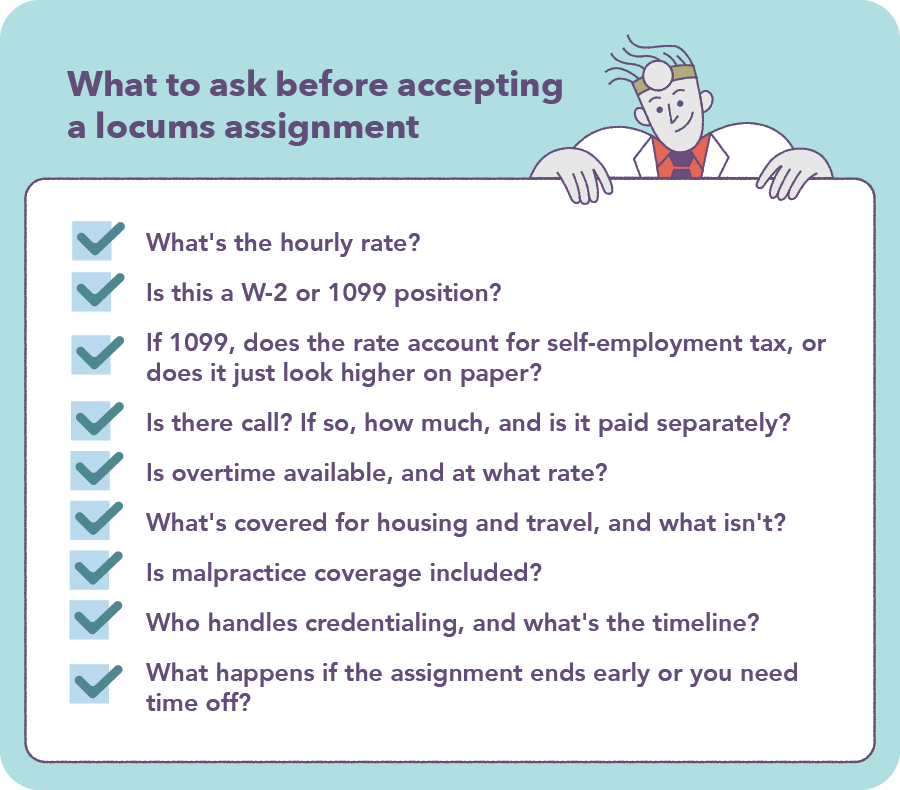
- What’s the hourly rate?
- Is this a W-2 or 1099 position?
- If 1099, does the rate account for self-employment tax, or does it just look higher on paper?
- Is there call? If so, how much, and is it paid separately?
- Is overtime available, and at what rate?
- What’s covered for housing and travel, and what isn’t?
- Is malpractice coverage included?
- Who handles credentialing, and what’s the timeline?
- What happens if the assignment ends early or you need time off?
A good recruiter will expect these questions and should have straight answers ready.
More on pay and locum tenens for PAs
Understanding the mechanics of how pay works is a good first step. Here are a few places to go deeper:
- If you want a closer look at how pay and benefits break down for PAs, CompHealth’s guide to PA locum tenens pay, benefits, and scheduling goes further into the specifics.
- For credentialing and licensing timelines, see our PA licensing and credentialing guide.
- If you’re still exploring whether locums is a good fit for you, our locums for PAs and NPs hub is a good next stop.
- Ready to talk specifics? Compare locum tenens agencies to find one that fits how you want to work.
And if you want to hear more from the PAs quoted in this piece, in their own words, check out the full conversations on the Locumstory Podcast:
- Alex Oliver on scope of practice and choosing assignments (episode 82)
- Kristin Burton on paying off student debt through locums (episode 68)
- Meg Walker on W-2 vs. 1099 (episode 65)
- Terry Rand on what to ask before you sign (episode 12)