
Locum tenens assignments are an exciting way to explore a new facility and location and earn invaluable experience. Before you set foot in the hospital or clinic, however, you need to complete the physician assistant credentialing process, which includes state licensing, facility and agency credentialing, and facility privileging.
Fortunately, experts have shared their advice to help you understand state and facility expectations and feel confident as you embark on your new job. Here’s our step-by-step guide to PA licensing and credentialing.
How is PA locum tenens credentialing different than regular credentialing?
While physician assistants who take permanent positions generally go through the credentialing process at the beginning of their careers and then re-credential as required afterward, the PA credentialing process for locum tenens repeats for every assignment. There are several reasons for this.
First, as with any new job, an employer needs to make sure you are who you say you are. This requires verifying your education and work history and contacting references. Second, if you are taking a locum tenens assignment in a different state from the one in which you live, you’ll need a separate state license and you’ll need to go through that state’s verification process as well.
Finally, facilities must verify that you can perform specific procedures through a process called privileging, which can require more paperwork and extend the PA credentialing process.
However, one of the benefits of working with an agency is having a team to help you with licensing, credentialing, and privileging. As soon as you’ve booked an assignment (and sometimes before), a team member will contact you about specific paperwork and documents you’ll need before you can head to work.
It’s also important to remember that when you want to jump into your assignment right away—especially if you’re filling in for another provider in an underserved area—the credentialing process can feel both rushed and slow at the same time. With help from your team and some preparation, you’ll be able to manage the requirements and get on the road (or in the air) to your new workplace.
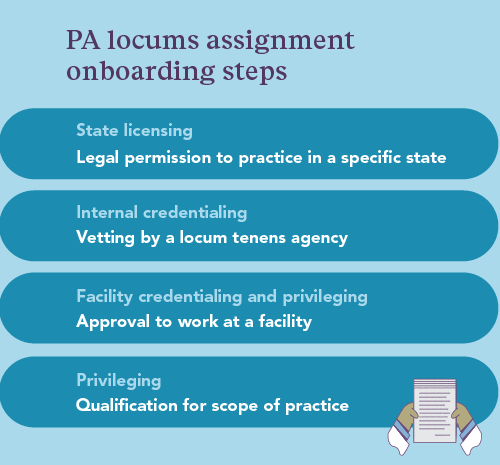
PA licensing vs. credentialing vs. privileging: What’s the difference?
Though these phrases are often used interchangeably within healthcare, the licensing, credentialing, and privileging processes are distinct but overlap. Here’s how they differ (and how they’re connected).
PA licensing
The licensing process refers to applying for, obtaining, and renewing licenses to practice in a specific state or states. While every state in the U.S. requires physician assistants to graduate from an accredited PA program and pass the Physician Assistant National Certifying Exam (PANCE) to obtain a license, other requirements vary by state.
Many stipulate a current certification from the National Commission on Certification of Physician Assistants (NCCPA), which you automatically receive when you pass the PANCE. To maintain the NCCPA certification, you have to earn 100 continuing medical education (CME) credits every two years. You must also take a recertification exam once every 10 years. Every state requires NCCPA certification, and may require a number of CME hours.
Additionally, PA licensing requirements may include a written agreement for supervision or collaboration with a physician that outlines the scope of practice, physician availability for consultation (often within one hour), and periodic chart reviews to ensure quality care. While many states are moving from PA “supervision” to “collaboration” agreements, the rules vary from state to state.
Derek Bradley, a senior licensing coordinator at CompHealth, says it’s his job to know the timeframes and help a PA start their assignment, whether they need a license, supervision agreement, or controlled substances authorization.
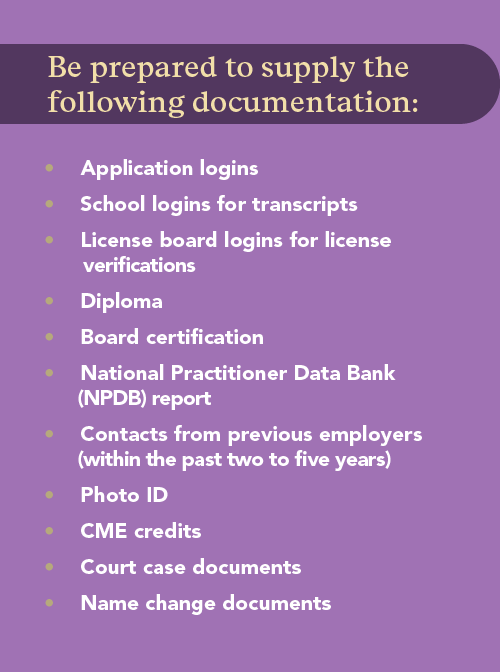
“We have a dedicated team that knows this information or has contacts, so the provider can focus on other things. Licensing is often the biggest hurdle to get someone to work,” he says. “We’ve created a list of possible things licensing may need for provider representatives so that when they call a PA, they can say, ‘Here are some things they may require.’ Then it’s not a shock when we ask for it, and they’re able to be better prepared up front and track down what they need.”
Bradley’s list includes:
- Application logins
- School logins for transcripts
- License board logins for license verifications
- Diploma
- Board certification
- National Practitioner Data Bank (NPDB) report
- Ink signatures
- Notarized documents
- Fingerprint cards
- Contacts from previous employers (within the past two to five years)
- Photo ID
- CME credits
- Court case documents
- Name change documents
Depending on the state requirements, you may also need to provide ink signatures, notarized documents, and fingerprint cards.
Because requirements are different depending on the state in which you plan to work and whether the state has a separate PA regulatory board instead of the state medical licensing board, the licensing timelines can vary widely. Once the PA Licensure Compact is live, it may streamline the licensing process for PAs in participating states.
Licensing delays most often occur when:
- States regulate PAs solely through medical boards instead of separate PA boards
- States have extra requirements for licensing, including letters of recommendation, jurisprudence exams, physician identification, and personal interviews
- PAs do not include all necessary documentation in their application
- Boards meet only monthly or quarterly to review licensing applications
“Licensing plays a big part in the timeline because you can’t force the state to budge on their timeline,” says Aly McDermott, senior hospital privileging coordinator at CompHealth. “The California board is currently taking six to eight weeks, so you’ll need to plan your assignment start date accordingly.”
If you’ll need a new license to work locum tenens, coordinate timing with your agency to make sure you are giving yourself enough time after submitting all documents and applications. Licensing can take anywhere from a couple of weeks to 120 days or longer. It all depends on the state and the facility.
Overwhelmed by paperwork? Use these organization tips
Locum tenens agency credentialing for PAs
Locum tenens agencies also have a process for credentialing the PAs that work for them. It consists of verifying a PA’s education, licenses, and references before they begin a locum tenens assignment. Agencies require this internal credentialing to ensure they hire quality providers and offer healthcare facilities an additional vetting process before they conduct their own credential review. Because most agencies also provide malpractice insurance, credentialing covers the application and verification process that malpractice insurance companies require.
To streamline the credentialing process, agencies generally have teams to coordinate the required paperwork and tests both for their own credentialing process and the process you will go through to work at a new facility. These agency teams work closely with the facility’s credentialing and privileging teams to ensure they don’t duplicate requests or overwhelm you.
“A bunch of different people will reach out to the PA during the process, so I like to do an intro call and create that first touchpoint contact. I can build that relationship and create calm for the provider. I can also help them prioritize the emails,” says Nate Garner, a senior credentialing specialist at CompHealth. “I might say, ‘Work with hospital privileging first because that’s what the facility needs, or start with licensing.’ With our internal credentialing, we have more control.”
Physician assistants must complete agency credentialing every two years, though the credentialing team also notifies them of documents and tests that must be renewed annually, like drug screens. This makes it easier for PAs to complete future assignments with the agency.
“To keep the process moving, check your email and stay responsive. Acknowledge that you received an email or phone call, and then stay on top of those requests,” Garner recommends. “Internal agency credentialing typically takes about two weeks total, but we can sometimes finish it in a week depending on the provider’s motivation to complete it.”
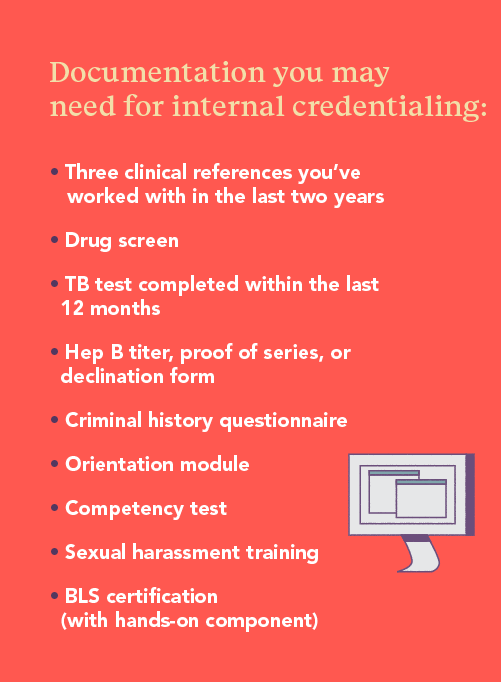
Below is a list of items an agency might require for their internal credentialing:
- Three clinical references you’ve worked with in the last two years
- Drug screen
- TB test completed within the last 12 months
- Hep B titer, proof of series, or declination form
- Criminal history questionnaire
- Orientation module
- Competency test
- Sexual harassment training
- BLS certification (with hands-on component)
Some of these documents and tests will also be required for hospital privileging, so the agency’s credentialing and hospital privileging teams work together to obtain any documents the PA has already submitted.
Facility credentialing and privileging for physician assistants
Physician assistant credentialing at a facility
In addition to your agency’s internal credentialing process, you must complete credentialing for the healthcare facility or health system you’ll be working for. This process ensures you are qualified to perform the procedures you were hired for and also protects both you and the facility from liability if you are charged with malpractice or negligence.
Facility credentialing requires verifying your education, licenses, certifications, work history, and qualifications through primary source verification, in which the hospital or clinic contacts the original source to verify the information is accurate.
Because of this process, you will rarely interact directly with a facility’s credentialing or privileging teams. However, your agency will work with them and try to simplify the process for you. McDermott says her team first contacts the facility to gather any paperwork and get a list of documents they need.
“I will pre-fill the facility’s application, and most of the time we can fill out 85% of it so that the provider has to fill out the remaining 15%. We send that application through DocuSign or can pre-fill an online app, which takes a huge chunk off the provider’s plate. It should maybe take them a half hour to finish it once we’re done,” she explains. “We will also request certificates of insurance from previous employers and can set you up for any immunizations you don’t have that the facility requires. We’re doing a lot behind the scenes and try to make it minimal for the provider.”
As part of the physician assistant credentialing process, McDermott recommends PAs contact their references to tell them they’ll get requests from both the facility and the agency. You should also have the following information ready:
- A CV that matches your agency application (check that certifications are not expired and that you include your entire work history)
- Copies of your diplomas, certifications, and immunizations
McDermott and her team can obtain case logs, conflicts of interest, and print copies of their license verifications from licensing board websites to save you time. She also works with credentialing, human resources, and employee health contacts to send you one request for everything they need rather than having four people email or call you.
“The biggest delays in the process come from not having all the information. The more in-depth a provider can be with a really good CV and agency app, the more smoothly everything will go,” McDermott says. “Create a folder in your email for a specific assignment, keep your documents in one place so they’re easy to send, and communicate with your agency. If, for whatever reason, a deadline isn’t going to work, communicate that. We have built relationships with the facilities and can talk to them about what you’re experiencing.”
Keep in mind that facility timelines for PA credentialing are often independent of locum tenens assignment start dates as well.
“You’ll see an assignment come through with a start date of July and think that you have plenty of time to get everything the facility needs. But when I ask the facility for their meeting schedules and deadlines, they want everything done by the beginning of April,” McDermott explains. “Sometimes a provider is slower on completing paperwork or requests because they think they have time, but some facilities have several approval meetings the file needs to go to. It’s a matter of communicating with them early about the dates.”
PA privileging
Although it is distinct from the PA credentialing process, privileging occurs concurrently to authorize physician assistants to perform specific procedures and tests at the facility. The Joint Commission, which administers primary-source verification, requires PAs to meet the same credentialing and privileging requirements as independent practitioners before providing or directing care. This includes:
- Helping with interventional or surgical procedures
- Performing physicals
- Ordering tests, procedures, and medicines
- Interpreting treatments and tests
Like facility credentialing, privileging requires a team to verify the PA’s licensure, education, and certifications. However, privileges are generally reviewed every one to three years.
Because of the requirements and the external teams involved in both facility credentialing and privileging processes, this step often takes the longest to complete—anywhere from several weeks to several months, depending on the facility. McDermott reminds PAs to have patience and stay in contact with their agency during that time.
“We’re here to help, and we’re on the same team. We want the provider to start just as much as you want to start,” she says. “We’ll work together to hit that end goal, and they will start their assignment on time.”
How long does PA licensing, credentialing, and privileging take?
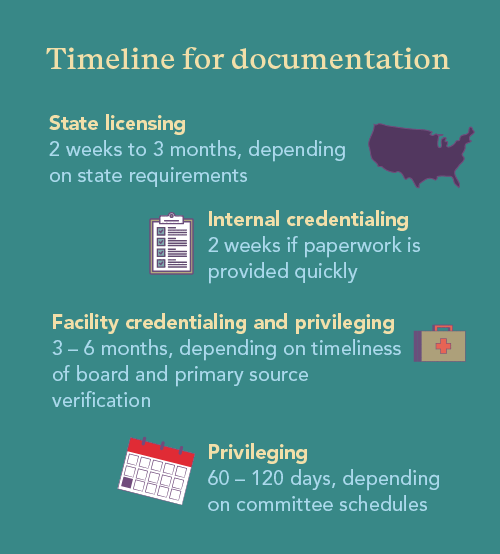
While the timelines for each process vary due to several factors, here are some expected ranges for licensing, credentialing, and privileging before you start your locum tenens assignment.
Licensing
- Plan on anywhere from two weeks to up to three months to receive your PA license, depending on the state and its specific requirements
- Coordinate timelines and required documentation with your agency, since states have differing approval processes and required documentation
Agency credentialing
- Depending on your agency and how quickly you fill out and provide the necessary paperwork and documents, you can complete an agency’s internal credentialing process in about two weeks
- Communicate often with your agency representative to ensure you get all information to them quickly, which often shortens the timeline
Facility credentialing
- Generally, the longest part of the PA credentialing process, facility credentialing can take at least three months and sometimes up to six months
- Factors affecting facility credentialing include the frequency of board and committee meetings and time for primary source verification
Privileging
- It can take 60 – 120 days to obtain hospital privileges
- Like with facility credentialing, this timeline can vary based on the schedule of credentialing committee meetings
How to streamline PA licensing, credentialing, and privileging
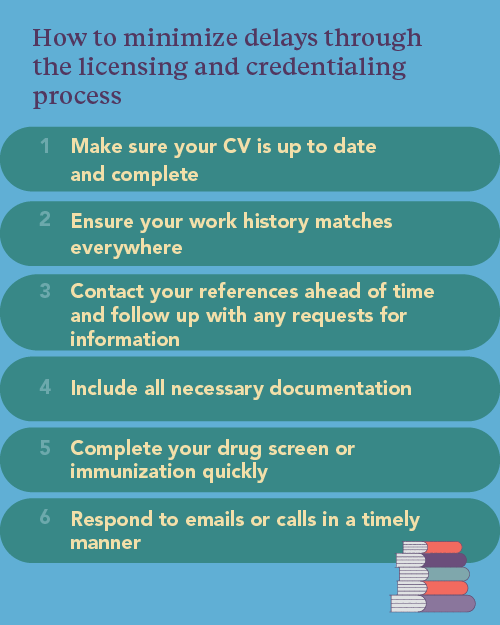
To avoid delays when completing the licensing, credentialing, and privileging processes before you start your locum tenens assignment:
- Make sure your CV is up to date and has a complete list of the places you’ve worked, including any temporary positions or locum tenens assignments
- Ensure your work history matches in all places you upload it
- Contact your references ahead of time so they know a facility and agency will be calling them, and check with them to make sure they submitted any information on time
- Include all necessary documentation and complete your drug screen or immunization quickly
- Respond to emails or calls from your agency so you can submit all necessary information and know about any delays or changes
While the credentialing, privileging, and licensing processes for locum tenens PAs can be a lot of work and sometimes confusing, a good agency is ready to help and simplify it for you so you’re ready to go for your locum tenens assignment. With some planning and organization, you’ll be at your new facility in no time and ready to enjoy new locum tenens experiences.