
As a family medicine physician, you are in high demand because of your broad training and flexibility: from newborns to older adults, chronic disease to urgent care, OB call to inpatient rounds. That’s also what makes you such a strong fit for locum tenens. Because of your training, you have more assignments to choose from than many other specialties.
But if you’ve never worked a locum assignment before, there’s a lot to sort out. This guide walks through what family physicians need to know before saying yes to a locum tenens assignment:
- How locum tenens actually works, and the family medicine settings available
- What it pays, and what’s included beyond the hourly rate
- How taxes work as a 1099 independent contractor
- Who’s responsible for malpractice coverage, and what to confirm before you assume you’re protected
- How state licensing works, and when the IMLC can help
- What credentialing involves, and how to stay ahead of it
- How to find a job, vet an agency or recruiter, and know what to ask before accepting an assignment
- What you actually gain, and give up, if you choose locums full time over a permanent job
What is locum tenens for family physicians?
Locum tenens is Latin for “to hold the place of.” In practice, it means temporarily stepping into a physician role when a clinic, hospital, or health system needs coverage. Sometimes it’s because someone’s on leave; perhaps a position is vacant while the facility recruits; maybe patient demand has spiked for the season; or a rural community simply doesn’t have enough family physicians to go around.
Assignments can run anywhere from a single weekend to a year or longer, and family physicians work them in a wide range of ways: full time, as a bridge between two permanent jobs, a handful of weekends scattered across the year to earn a little extra on the side, or a slow ease into retirement. Unlike a traditional job, locum tenens gives you a lot more say over when, where, and how much you work. For a specialty as broad as family medicine, locums can open up a genuinely wide set of options.
Why family physicians choose locum tenens
There isn’t one typical way family medicine locum physicians choose to work locum tenens. A new attending might use locums to try out different practice settings before signing a long-term contract. A physician fifteen years into a private practice might use it to dial back a schedule that’s stopped working for them. Someone easing toward retirement might use it to keep practicing on their own terms, without the administrative weight of running a full-time operation.
Ask physicians why they actually made the switch, though, and the honest answer is rarely just about the job. Here are some of the most common reasons you’ll find family physicians give for trying locums:
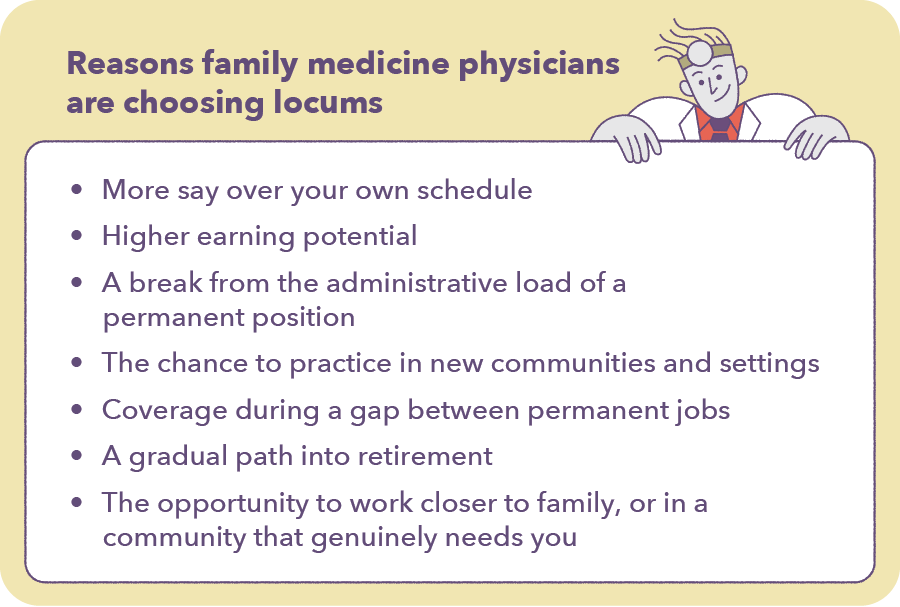
- More say over your own schedule
- Higher earning potential
- A break from the administrative load of a permanent position
- The chance to practice in new communities and settings
- Coverage during a gap between permanent jobs
- A gradual path into retirement
- The opportunity to work closer to family, or in a community that genuinely needs you
For Dr. Victoria Hasselhoff, a family medicine physician who went straight from residency into locum tenens, the decision barely felt like one. “You’re gonna pay me to go other places and essentially live my dream while also doing the job I love? This is a no-brainer.”
Dr. Jordan Salmon, an Air Force veteran, used locum tenens and telehealth shifts to cover the gap while he built his own private practice from the ground up. He was able to adjust his schedule with however much time, or money, he needed that month.
For Dr. Eberechi Ekechukwu, the timing lined up with a different kind of transition: her kids leaving for college and a divorce landing in the same stretch of life.
And for Dr. Lisa Kennedy, who spent nearly thirty years running her own practice, the hardest part wasn’t deciding to leave. It was realizing, only once she had, how long she’d been running on empty. “I hadn’t realized I was burned out in private practice until I left.”
Why family medicine is a natural fit for locums
Here’s the real reason it works: Locum assignments aren’t one-size-fits-all. A rural clinic might need someone who can see newborns, deliver babies, and round at the hospital, all in the same week. An urgent care a few towns over might only want acute visits. A community health center might just need a standard outpatient panel covered for a few months. Depending on your background and the facility’s needs, options include:
- Preventive care and wellness visits
- Acute illness and injury
- Chronic disease management
- Pediatrics
- Women’s health
- Geriatrics
- Behavioral health
- Hospital medicine
- Urgent care
- Procedures and obstetric care where your training and privileges allow
Your training might be broader than the scope you’re currently practicing in day to day, so don’t assume an assignment automatically excludes a skill you haven’t used in a while—and don’t assume it includes one you perform regularly, either. Ask the facility directly what they expect you to do before you accept.
Types of family medicine locum assignments
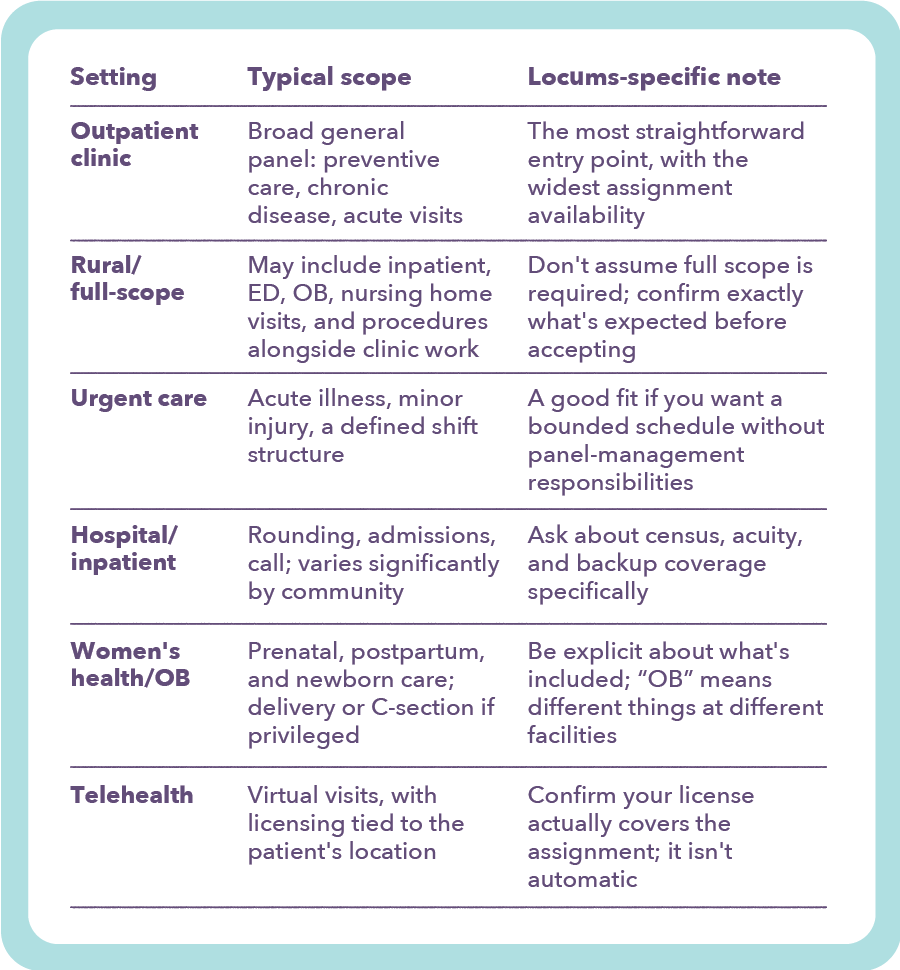
Family medicine locums can look fairly different from one assignment to the next, so it helps to know roughly what each setting tends to ask of you.
Outpatient family medicine is the most straightforward entry point and the one with the widest availability: a broad patient panel, annual physicals, chronic condition management, and the everyday rhythm of a primary care clinic.
Rural family medicine tends to ask for more. Many rural communities lean on one family physician to cover a much broader scope than an urban clinic would: inpatient coverage, obstetrics, nursing home visits, sometimes emergency department responsibilities, depending on the town. Dr. Lynn Smith, who took a locum assignment on the Navajo Nation between a retirement and a move to New Zealand, still thinks every family physician should try it at least once.
“I think every family practice person should spend a few months on the Navajo Indian Reservation. It’s the most humbling thing you’ll ever do,” Dr. Smith said.
Dr. Smith’s takeaway from years of rural and international assignments comes down to one word, repeated three times: flexible, flexible, flexible!

Urgent care assignments tend to run the other direction—a defined shift, acute and minor-injury visits, and none of the longitudinal panel management that comes with a traditional clinic. If you want a bounded schedule without the responsibility of managing a patient panel over time, this setting is usually a better fit than outpatient family medicine.
Hospital and inpatient coverage shows up in communities where family physicians still round and admit, and it varies a lot by location—ask specifically about patient census, acuity, call responsibilities, and what backup looks like if things get busy.
Women’s health and obstetrics assignments depend heavily on your training and current privileges. “OB” can mean very different things from one facility to the next, so be explicit with your recruiter about what you actually want: prenatal care only, deliveries, C-sections, OB call, newborn care. Dr. Alison Liewen switched back to locum work specifically to protect this part of her scope, after a permanent job left her seeing mostly geriatric patients.

Telehealth is the newest entry on this list, and licensing is the thing most people get wrong about it: your existing license doesn’t automatically cover a telehealth assignment, since the rules are usually tied to where the patient is physically located, not where you are. Confirm this before you take the assignment, not after. Dr. Salmon’s first telehealth assignment came with its own learning curve.
“Meeting someone for the first time over a phone call, doing the whole encounter without a face-to-face follow-up—figuring out how to make sure care was still delivered appropriately was a new set of questions I had to learn to ask,” Dr. Salmon said.
A quick side-by-side, since the differences between settings matter more than the labels suggest:
How much do family medicine locums pay?
This is usually the first question on anyone’s mind, and it’s also the one with the least satisfying answer: it depends. According to Locumstory’s pay trends tool, the average falls between $120 and $135/hour. However, location, assignment length, practice setting, call responsibilities, patient volume, procedures, and your own experience all move the number, sometimes by a lot.
It’s also worth comparing the full package, not just the hourly or daily rate. Depending on the assignment and agency, that package can include housing, travel, malpractice coverage, licensing costs, credentialing support, and per diem for meals—all of which change what the job is actually worth to you.

Dr. Hasselhoff found this out the hard way during her first few assignments. The clinical side of locums came easily to her. Figuring out what she was worth didn’t.
“The hardest part wasn’t clinical. It was knowing my value—not really having an anchor point for what my time was worth,” Dr. Hasselhoff said.
So the better question usually isn’t “what’s the hourly rate.” It’s what you’ll actually take home once you’ve accounted for the full compensation package and your own expenses as an independent contractor.
Get the latest trends: Pay trends by specialty
Are family medicine locums independent contractors?
Most locum tenens physicians work as 1099 independent contractors rather than traditional W-2 employees. That means you’re generally responsible for your own federal and state taxes, health insurance, and retirement planning—none of which gets automatically withheld from a locums paycheck the way it would at a permanent job.
For more on working as an independent contractor: Read the full 1099 v W-2 guide
Your agency typically handles payment for the clinical work itself and may cover certain assignment-related expenses, but the tax side is on you. Because 1099 situations vary quite a bit by state and individual circumstance, it’s worth working with an accountant who’s handled physician locums income before.
Dr. Hasselhoff’s advice here comes from direct experience—and a few thousand dollars she didn’t realize she was leaving on the table.
“I missed out on a lot of deductions in my first few jobs because I didn’t know about certain things,” Dr. Hasselhoff said.
Need more information on how taxes work? Read our full tax guide for locum tenens
Who pays for malpractice insurance?
One real advantage of working through a locum tenens agency is that malpractice coverage is usually built into the assignment. That said, the specifics can vary more than people expect, so don’t assume every assignment carries identical protection. Before accepting, ask about the coverage limits, whether the policy is claims-made or occurrence-based, whether tail coverage is included, and what happens to your coverage once the assignment ends.
Locumstory’s malpractice guide breaks down the differences between policy types in more depth, including the questions worth asking before you sign anything.
Do family physicians need additional state licenses?
If you’re physically practicing in a state where you’re not already licensed, you’ll generally need to get licensed there first—though the good news is you don’t have to navigate that process entirely on your own. Most agencies have a team dedicated to managing the paperwork.
The IMLC, explained
The Interstate Medical Licensure Compact can speed up licensing considerably for eligible physicians working across multiple participating states. It’s not universal, though: not every physician or every state qualifies, so it’s worth understanding the specific requirements for wherever you want to practice before counting on it.
It’s also worth keeping licensing, credentialing, and privileging straight, since people tend to use the three interchangeably when they’re actually separate steps: Licensing is the state’s legal permission for you to practice medicine, credentialing verifies your qualifications, and privileging determines what you’re specifically authorized to do at a given facility.
What is credentialing like for locum family physicians?
Credentialing is one of the less exciting parts of locums, but it’s unavoidable, and it tends to repeat itself: Every new facility has to independently verify that you’re qualified to practice there, which means you may go through some version of this process several times over the course of a locum career. Typical documentation includes medical school records, residency verification, state licenses, board certification, work history, references, malpractice history, CME records, relevant certifications, and DEA registration where applicable.
A good agency will help coordinate this: gathering documents, communicating with facilities, keeping things moving. Keep in mind that your own organization style still matters. Here are some simple tips to stay ahead of it:
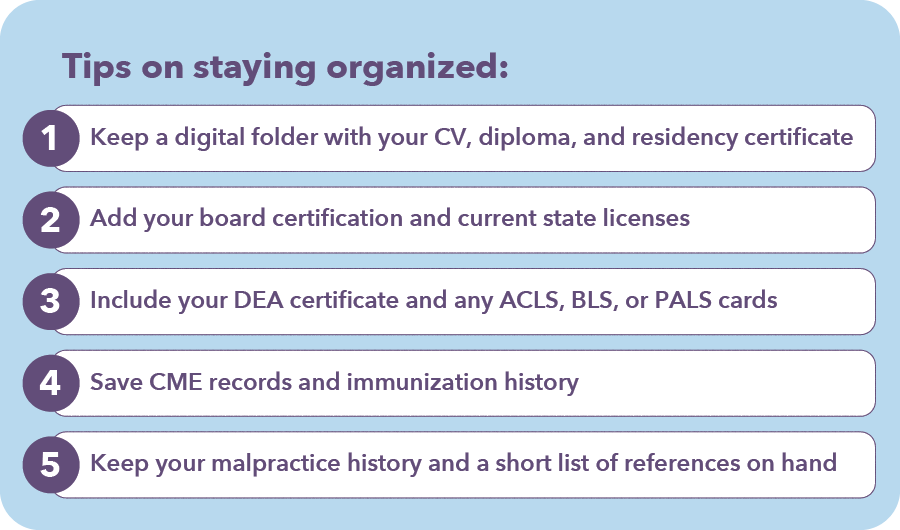
- Keep a digital folder with your CV, diploma, and residency certificate
- Add your board certification and current state licenses
- Include your DEA certificate and any ACLS, BLS, or PALS cards
- Save CME records and immunization history
- Keep your malpractice history and a short list of references on hand
And when a credentialing team asks for something, send it quickly. A delayed signature or a missing document is a common reason a start date slips, and a slipped start date can cost you real shifts.
How do you find a family medicine locum job?
You have two real paths here: work with an agency or handle it yourself.
Working with an agency
An agency can identify assignments, negotiate your contract, coordinate licensing and credentialing, arrange travel and housing, and carry your malpractice coverage. The agency is generally paid by the healthcare facility, not by you.
Start by checking whether a prospective agency belongs to the National Association of Locum Tenens Organizations, which requires member agencies to follow a shared code of ethics and maintain certain industry standards. From there, a short conversation with a few recruiters tends to reveal a lot about their communication style, how well they understand family medicine, and whether they’re actually listening to what you want.
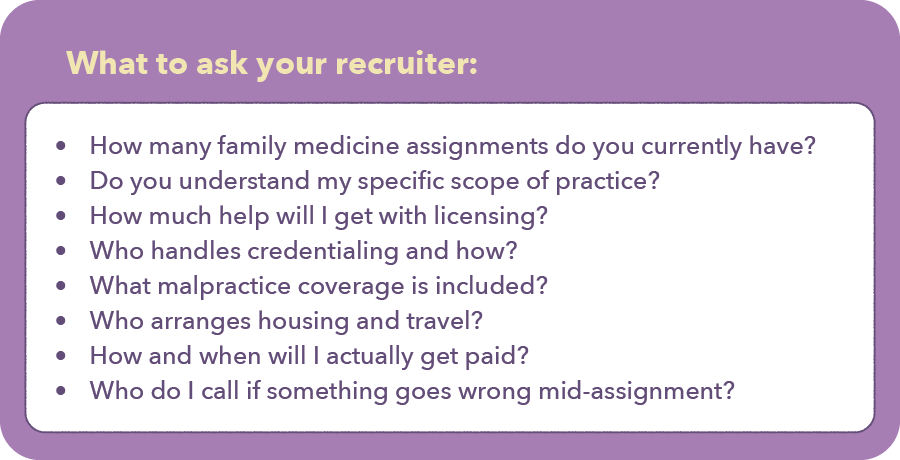
Worth asking any recruiter you’re considering:
- How many family medicine assignments do you currently have?
- Do you understand my specific scope of practice?
- How much help will I get with licensing?
- Who handles credentialing and how?
- What malpractice coverage is included?
- Who arranges housing and travel?
- How and when will I actually get paid?
- Who do I call if something goes wrong mid-assignment?
Dr. Hasselhoff’s advice, after working with a couple of recruiters she liked and at least one she didn’t:
“Don’t settle just with the first person who contacts you. Kind of interview the people—see who can work best with you, because there are so many out there,” Dr. Hasselhoff said.
Not sure where to start? Check out our agency comparison tool.
Going it alone
Some physicians contract directly with a facility instead. It can mean more direct control over the relationship, but you’ll also handle sourcing, negotiating, licensing, credentialing, malpractice coverage, travel, housing, and invoicing yourself. For most physicians, the time an agency saves is worth more than whatever you’d gain by skipping one, at least until you have a few assignments under your belt.
What should you look for in a family medicine locum assignment?
The job description only tells you part of the story. Before you say yes, it’s worth asking about the actual day-to-day, not just the pay.
Clinical expectations
- What does the patient population look like, and how many patients per day?
- How long are appointment slots, and is there nursing or MA support for each physician?
- What procedures, if any, are expected?
- Are there inbox responsibilities, after-hours call, or inpatient duties?
- Is obstetric care part of the role?
Practice environment
- What EMR does the facility use, and how much orientation will you get?
- Who handles referrals, and what specialists are available locally?
- What’s the process for admitting or transferring a patient?
- Is there another physician around for questions, or are you the only one?
Schedule
- How many days a week, and what are the clinic hours?
- Is there weekend coverage or call?
- Are shifts guaranteed, and can you request specific dates?
These details often matter as much as the pay rate itself, sometimes more, depending on what you’re actually looking for out of the assignment.
How family physicians use locum tenens in their careers
Ask eight different family physicians why locums works for them, and you’ll get eight different answers, which is sort of the point of a specialty this broad.

Rural and underserved coverage
Many rural and underserved communities depend heavily on family physicians willing to take on a wider scope than a typical urban clinic requires. Dr. Smith spent time on the Navajo Nation; Dr. Liewen has split her locums career between small towns in Alaska and Northern California, much of it with Indian Health Service facilities. Both describe the same tradeoff: fewer resources, but patients and communities that are, in Dr. Smith’s words, “immensely grateful” for a trained physician willing to show up.
Reclaiming full-spectrum scope
Not every permanent job keeps your full training in use. Dr. Liewen took locum assignments specifically to rebuild the pediatric and women’s health skills a geriatric-heavy permanent role had let slip. That’s an example of how locums can work as a corrective, not just an exit.
Bridging a career transition
Dr. Salmon used locum tenens and telehealth shifts as flexible income while he got his own private practice off the ground, scaling his hours up or down depending on what the business needed that month.
Life-stage reinvention
For Dr. Ekechukwu, locums arrived at the same time as a major life change and gave her somewhere to redirect that energy. Travel has its frustrations, she’ll admit, especially when a delayed flight threatens to collide with a night shift in a different state entirely. But the trade felt worth it.
Easing into semi-retirement
Dr. Kennedy didn’t plan to stay in locums this long when she closed her private practice after almost thirty years, but eight years later, she hasn’t looked back. Dr. Coleen Haynes, a hospitalist with a family medicine background who picked up locums work later in her career, put it more bluntly.
“I’m kind of mad at myself that I didn’t explore this option years ago,” Dr. Haynes said.
Dr. Elyas Parsa, a former residency program director 12 years into the same institution, framed his own decision to take a locum assignment in New Zealand as less about retirement and more about avoiding stagnation.
“I was a little bit on autopilot. Once you get on autopilot, it’s time to reset—to try to challenge yourself in some way or another,” Dr. Parsa said.
New-grad exploration
And then there’s the path Dr. Hasselhoff took: straight from residency into locums, using assignment after assignment to test out different places before settling anywhere. If you’re closer to the start of your career and weighing this path specifically, Locumstory’s guide for residents and new graduates covers that decision in more depth than this guide can.
What are the downsides of family medicine locums?
Locum tenens isn’t automatically better than a permanent job, and pretending otherwise would undercut the point of this whole guide.
Your assignment has an end date, which can lead to less stability and occasional gaps between jobs if you don’t plan ahead. Every new practice comes with its own workflow, EMR, staff, and expectations, so you’re constantly adapting rather than relying on routine. You generally won’t get employer-sponsored health insurance, retirement contributions, or paid time off. Credentialing repeats itself more often than anyone would like. And if you’re someone who builds your identity around following a patient and their family for years, locums will feel different; you’re walking into a relationship that was never designed to be permanent.
Should I try family medicine locum tenens?
There’s no universal answer. Locums tends to fit well if you like variety, adapt easily to new environments, want more control over your schedule, or are somewhere between permanent positions and not in a hurry to land on the next one. If you strongly prefer long-term patient relationships, a predictable team, traditional employee benefits, and minimal travel, locums may not be for you.
Neither answer is the wrong one. The important thing is to figure out honestly whether it fits your life stage, goals, needs, and personal career preferences.
Family medicine locums FAQ
What does a family medicine locum tenens physician do?
A family medicine locum physician temporarily fills a role at a clinic, hospital, urgent care center, or other facility. Depending on training and privileges, that can include preventive care, chronic disease management, pediatrics, women’s health, inpatient coverage, procedures, or obstetrics.
How long do family medicine locum assignments last?
Anywhere from a few days to a year or more. Some physicians also take recurring assignments, working a set number of days or weeks each month.
Do family medicine locum physicians get malpractice insurance?
Most agencies include malpractice coverage as part of the assignment, though the specific policy and limits vary. Review the terms for each assignment rather than assuming they match the last one.
Do I need a new license for every locum assignment?
Not necessarily. You need a license in each state where you’ll practice, but one license can cover multiple assignments within that state. Eligible physicians may also be able to speed up multi-state licensing through the Interstate Medical Licensure Compact.
Do locum physicians have to find their own housing?
Not usually. Depending on the assignment and agency, housing is often arranged or reimbursed as part of the deal—but confirm the specifics before you travel, especially if you’re bringing family or a pet along.
Can family physicians work locums part time?
Yes. Locums ranges from occasional, local coverage to a full-time schedule. Some physicians use it as supplemental income alongside a permanent job; others make it their primary way of practicing.
Can I work locums close to home?
Yes. Locums doesn’t have to mean cross-country travel. Local and regional assignments are increasingly common, depending on demand in your area.
Is family medicine in demand for locums?
Yes. Family medicine plays a significant role in primary care access, particularly in rural and underserved areas, and primary care shortage projections from the AAFP and AAMC point to continued demand in the years ahead.
Can locums turn into a permanent job?
Sometimes. Some physicians and facilities use a locum assignment specifically to test whether a permanent relationship makes sense for both sides before committing to one.
Is family medicine locum tenens worth it?
It depends on what you’re looking for. It tends to suit physicians who value flexibility, variety, and more control over their schedule, and it tends to suit them less if long-term patient relationships and a predictable routine matter more to you than either of those things.
How do I get started with family medicine locums?
Start by getting clear on what you actually want out of it—flexibility, extra income, a change of scenery, a career transition, or something else entirely—then look for assignments that match your clinical background, schedule, and preferred locations. Locumstory’s free Locums Crash Course covers the basics: assignments, malpractice, agencies, licensing, credentialing, compensation, and taxes.