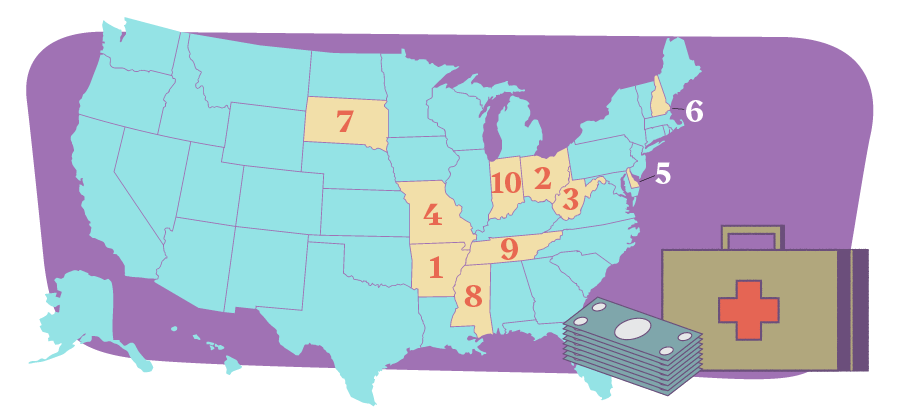
Locum tenens continues to offer physicians a flexible way to practice medicine while earning strong compensation, but where you work still matters. To identify the top-paying states for locum tenens, Locumstory analyzed the past 12 months of pay data across all specialties and compared average daily rates by state.
The result: While the most lucrative states for locum tenens physicians still skew toward rural and high need areas, 2026 shows a subtle shift compared to years prior. The Midwest is emerging as a stronger draw, though pay remains heavily influenced by specialty. Physicians in psychiatry, emergency medicine, and select surgical fields continue to command the highest daily rates.
While pay for locum tenens remains well above the national median in top markets, more states are competing for a limited physician workforce, but the gap is narrowing slightly.
Below are the highest-paying states for locum tenens physicians in 2026, ranked by how much they pay above the national median, along with what’s driving demand in each.
1. Arkansas: 128%
Arkansas remains the highest-paying state for locum tenens physicians, though its margin has narrowed slightly from last year (132%). Several counties in the state are classified as a health professional shortage area (HPSA), with particularly acute needs in primary care and behavioral health/psychiatric care. Almost half of residents live in rural areas where they have less access to healthcare.
This geographic reality makes recruitment and retention of full-time physicians even more challenging. Combined with a limited in-state training pipeline and an aging physician workforce, facilities continue to rely heavily on locum tenens physicians—and pay a premium to secure them.
2. Ohio: 124%
In 2026, Ohio jumps significantly into the number 2 spot of top-paying locum tenens destinations (up from 2025’s spot at number 6), offering compensation at 124% of the national median. This signals growing demand across both urban and rural regions. More than half of the state’s counties are designated HPSAs, and millions of residents live in areas with limited access to care.
The state is also facing a projected shortfall of primary care physicians, while hospital systems, particularly in Appalachian and inner city regions, depend on locums to maintain service levels.
This combination is pushing compensation higher relative to the national median.
3. West Virginia: 121% (Tied)
West Virginia continues to offer strong compensation for locum physicians; locum tenens providers earn 121% of the national median here.
Over 95% of West Virginia’s counties are designated HPSAs, and recent closures of healthcare facilities have created significant access gaps. The state faces persistent staffing challenges, particularly in family medicine and behavioral health, due in large part to its aging physician workforce, declining medical school enrollment, and high burnout, not to mention still lingering effects of the COVID-19 pandemic.
Chronic disease and substance use rates are among the highest in the nation, and West Virginia ranks as the country’s unhealthiest state, with the highest number of drug overdoses, the highest adult smoking and obesity rates, and the second-shortest life expectancy. Rural hospital closures have intensified provider shortages, and facilities often turn to locum tenens physicians to stabilize care delivery.
What’s the trend? Compare 2025’s list of top-paying states for locums
3. Missouri: 121% (Tied)
Missouri climbs the list as locum tenens pay rises to meet growing demand across the state’s healthcare system. Large rural regions, especially in southern Missouri, continue to face significant physician shortages, with many counties lacking sufficient primary care coverage.
Financial pressures on smaller hospitals, including risks of closure, have increased reliance on temporary physicians to maintain essential services. Since 2014, 10 rural hospitals in Missouri have shut their doors, according to the Missouri Times.
Missouri is a competitive market for temporary clinicians due to a high demand for primary care, psychiatry, and emergency medicine, which skyrockets local locum tenens pay above the national median.
4. Delaware: 120%
Delaware remains a consistently high-paying state for locum tenens physicians. Despite its small size, the state faces ongoing provider shortages, in part due to the absence of a traditional in-state medical school pipeline.
Rapid population growth and an aging demographic are increasing demand for both primary and specialty care. With limited local supply, healthcare systems often compete for out-of-state physicians, which in turn drives up locum tenens compensation.
Oh! The places you’ll go: One physician’s experience working in many different places
5. New Hampshire: 118%
New Hampshire joins the list this year. According to the Commission on Aging, the state has one of the oldest populations in the country (second only to Maine). This reality increases demand for healthcare services, particularly in primary care and geriatrics.
At the same time, physician recruitment is complicated by regional competition from larger healthcare markets, such as Boston. With a limited pipeline of new providers and growing demand, healthcare systems are turning to locum tenens physicians to fill gaps.
6. South Dakota: 118%
South Dakota remains one of the top-paying states for locum tenens. Though its pay percentage relative to the median dropped 1% compared to 2025, it climbed one position on the list.
Nearly half of the state’s population lives in rural areas, and many counties lack consistent access to mental health providers.
Geographic isolation and harsh winter conditions make recruitment challenging, particularly for emergency medicine and primary care roles. Locum tenens physicians play a critical role in keeping rural facilities staffed year-round.
Go where you’re needed the most: 9 locations that desperately need locum physicians
7. Mississippi: 117%
Mississippi drops in rank this year, from paying 128% relative to the national median and ranking second to 117% and ranking eighth. Even so, the state continues to pay well above the national median. The state has one of the lowest physician-to-population ratios in the U.S., and a large percentage of counties are designated as HPSAs.
Relative to other U.S. states, Mississippi consistently ranks near the bottom for most health outcomes, including high rates of chronic illness, and over half of its counties lack adequate maternity care services.
High rates of chronic illness, combined with widespread rural access issues, create sustained demand across multiple specialties. Many hospitals rely on locum tenens physicians not as a stopgap but as an ongoing staffing strategy—and they will pay top dollar for the convenience.
8. Tennessee: 115%
Tennessee remains on the list, climbing two spots from 2025 as population growth and ongoing healthcare access challenges drive demand for locum tenens physicians. Many of the state’s rural counties face persistent provider shortages. And the state’s urban systems are straining due to the inverse: increased patient volumes.
Tennessee’s relatively high rates of chronic disease and uneven access to care reinforce continued reliance on locum tenens physicians.
9. Indiana: 114%
Indiana holds its position among the highest-paying states for locum tenens physicians in 2026, with average compensation reaching 114% of the national median.
More than half of Indiana’s counties are designated as HPSAs, particularly in primary care. At the same time, demand for behavioral health services continues to rise, with many communities lacking adequate psychiatric coverage.
This imbalance is especially pronounced outside major metro areas, where recruitment challenges persist. As a result, healthcare systems across the state frequently use locum tenens physicians to fill gaps in psychiatry, emergency medicine, and primary care—keeping compensation above the national median.
10. Rhode Island: 113%
Rhode Island rounds out the high-paying states for locum tenens physicians, offering compensation roughly 13% above the national median. Despite its small size, the state faces persistent provider shortages in primary care and mental health.
Population density is high, but urban centers like Providence still struggle to meet patient demand, and some suburban and rural areas experience gaps in specialty coverage. Limited local medical training programs and competition from neighboring states, such as Massachusetts and Connecticut, drive facilities to rely on locum tenens physicians to maintain staffing levels.
With ongoing demand in specialties like psychiatry, internal medicine, and emergency medicine, Rhode Island offers locum tenens physicians strong earning potential.
Trends shaping locum tenens pay in 2026
This year’s top-paying states for locum tenens highlight a few important trends:
- Pay remains strong, but less extreme at the top. Even the highest-paying states are slightly closer to the national median than in previous years.
- Midwestern states are gaining ground. Ohio and Missouri’s rise reflects growing demand in regions not always associated with the highest locum pay.
- Rural access challenges still dominate. Nearly every state on the list has a significant rural population or widespread HPSA designations.
- More states are competing for physicians. Instead of a few outliers, more states are clustering in the 115 – 120% range above the median.
Locum tenens remains a high-earning, high-impact option
Accepting assignments in an unfamiliar state can be rewarding and lucrative, especially if you’re willing to work in high-need and rural areas.
The top-paying states for locum tenens in 2026 reinforce a consistent pattern: The highest compensation is tied to the greatest need. States with physician shortages, rural access challenges, and growing patient demand are willing to pay a premium for coverage.
For physicians who are flexible about location, locum tenens offers a clear opportunity to maximize earnings while making a meaningful impact in underserved communities.