If you’re a nurse practitioner considering locum tenens, you’ve probably heard terms like licensing, credentialing, and privileging used almost interchangeably. And if it feels confusing, you’re not alone.
For many NPs, this process is one of the biggest mental hurdles to getting started. Not because it’s impossible, but because it’s unfamiliar, layered, and often happens behind the scenes.
The reality is that locum tenens onboarding does involve more steps than a traditional employed role. You’re often working across different states and facilities, and each one has its own requirements. But once you understand how the pieces fit together—and what’s actually expected of you—the process becomes much more manageable.
This guide walks you through exactly how it works, step by step, so you can move forward with clarity and confidence.
Licensing, credentialing, and privileging: What’s the difference
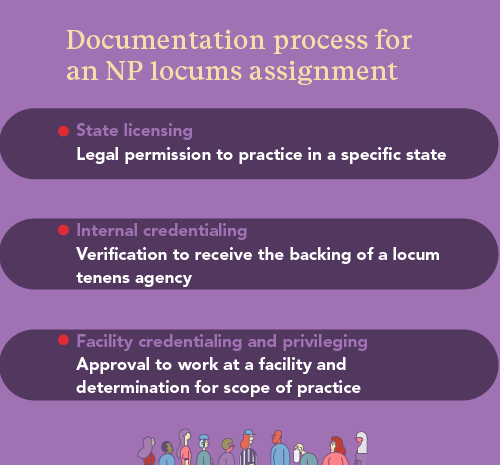
Even though these terms are often grouped together, they refer to three separate processes:
1. State licensure
This is your legal permission to practice as a nurse practitioner in a specific state.
It includes:
- Your RN license (in most cases)
- Your APRN or NP license
- Any required state-specific approvals (like prescriptive authority or supervision agreements)
2. Agency credentialing
Before you can be placed in a locum assignment, agencies verify your background, experience, and qualifications.
This is essentially a quality and safety check that confirms:
- Your education and training
- Work history
- Certifications and licenses
- References
3. Facility credentialing and privileging
This is the hospital or clinic’s process for approving you to work in their specific facility.
Credentialing verifies your qualifications for the health system. Privileging determines exactly what you’re allowed to do clinically at that location (based on your scope and experience).
Why these get mixed up
They all require similar documentation—your CV, licenses, certifications, and references—so it can feel repetitive. But each step serves a different purpose, and they often happen at the same time. Understanding that distinction upfront helps set realistic expectations for what’s coming next.
Let’s break these down further.
Step 1: State licensure for locum tenens nurse practitioners
Before you can start a locum assignment in a new state, you need to be licensed there. That’s where most NPs begin the locums process.
How RN and APRN licensure work together
For nurse practitioners, licensure typically happens at two levels: an RN license and an APRN/NP license. Some states require your RN license to be active before you can apply for your NP license, which can add an extra step, depending on where you plan to practice.
What about compact licenses?
If you hold a multistate RN license through the Nurse Licensure Compact (NLC), you may already be authorized to practice as an RN in multiple states.
However:
- The NLC does not automatically cover APRN licensure
- All states require a separate NP license
Note, there is an APRN Compact, but adoption is still several years away, so NPs still need to apply state by state.
When you need a new license
You’ll typically need to apply for a new license when:
- You accept an assignment in a state where you’re not currently licensed
- The assignment requires additional state-specific approvals (like controlled substance registration or supervision documentation)
What the licensing process looks like
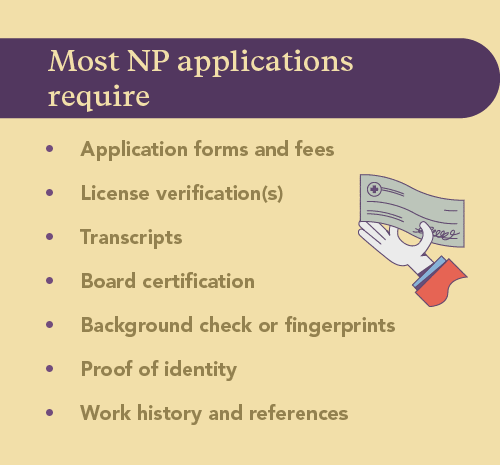
While requirements vary by state, most applications include:
- Application forms and fees
- License verification(s)
- Transcripts
- Board certification
- Background check or fingerprints
- Proof of identity
- Work history and references
The checklist can feel long—and in some cases, it is. But much of it is standard across states, which means once you’ve gathered everything once, future applications tend to move faster.
How long licensing takes
Licensing timelines vary significantly by state, but most fall within a general range of:
- 3 – 5 weeks (faster states)
- 6 – 8 weeks (typical)
- 10 – 12+ weeks (slower or more complex states)
Some states move faster. Others require additional steps, such as fingerprinting, supervision approval, or board review.
What causes delays
Licensing delays are common but often preventable. The most frequent issues include:
- Missing or incomplete applications
- Delays in primary source verification (like transcripts sent directly from schools)
- Additional requirements not clearly listed upfront
- Slow responses from state boards
“Sometimes a state’s website lists requirements A, B, C, and D, but once you apply, you find out you also need E and F. Then a month later, the board comes back and says you’re still missing something,” says Derek Bradley, senior licensing coordinator for CompHealth.
That unpredictability is part of why preparation and guidance can make such a difference.
Be prepared: 9 questions to ask before accepting an NP locum assignment
Step 2: Credentialing with the locum tenens agency
Once licensing is underway (or sometimes even before), you’ll need to be credentialed by the locum tenens agency.
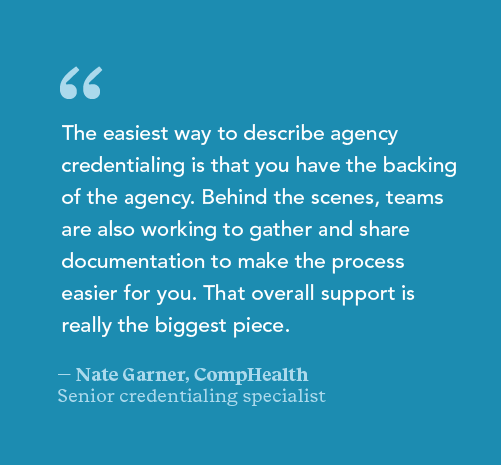
“The easiest way to describe agency credentialing is that you have the backing of the agency,” says Nate Garner, a senior credentialing specialist for CompHealth. “That includes things like malpractice coverage, so you don’t have to secure that on your own. Behind the scenes, teams are also working to gather and share documentation to make the process easier for you. That overall support is really the biggest piece.”
That agency backing helps ensure facilities can trust that your qualifications have already been thoroughly reviewed.
What agencies are verifying at this stage
Agency credentialing verifies that you’re qualified, compliant, and ready to work across different assignments.
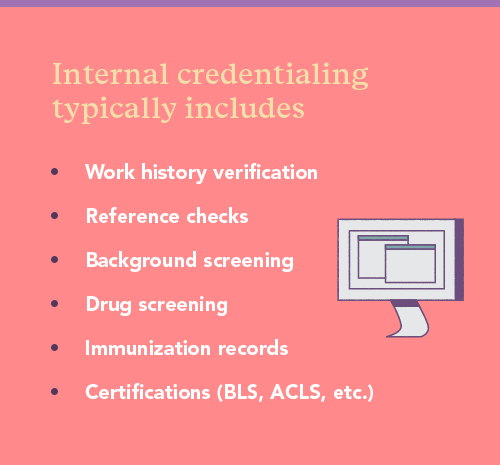
It typically includes:
- Work history verification
- Reference checks
- Background screening
- Drug screening
- Immunization records
- Certifications (BLS, ACLS, etc.)
For many NPs, this part feels repetitive, but it plays an important role.
What to expect during the credentialing phase
You’ll likely be contacted by multiple agency representatives at once: credentialing, licensing, and possibly privileging coordinators. It can feel like a lot at first. The good news is that much of this happens in parallel, and once your core file is complete, it can be reused for future assignments (with updates as needed).
How credentialing helps you long term
Unlike facility credentialing, agency credentialing is not fully repeated every time.
Once your file is established:
- Future assignments are faster to process
- Many documents can be reused
- Updates are typically incremental (new references, updated certifications, etc.)
Step 3: Facility credentialing and privileging
This is often the most time-consuming—and misunderstood—part of the process.
What facilities are verifying
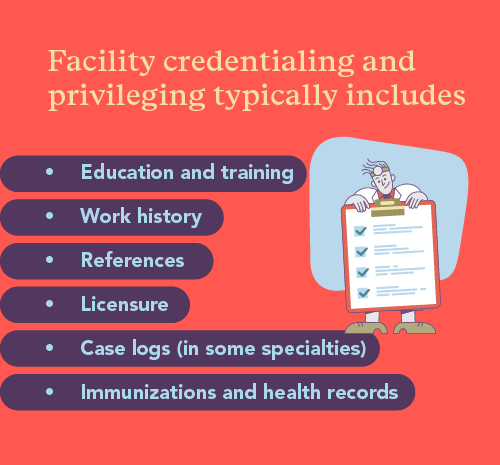
Each health system, hospital, or clinic conducts its own review of your qualifications.
This includes:
- Education and training
- Work history
- References
- Licensure
- Case logs (in some specialties)
- Immunizations and health records
They are responsible for ensuring patient safety within their organization, which is why this process is detailed and highly structured.
Credentialing vs. privileging
Credentialing confirms you’re qualified, whereas privileging defines what you’re allowed to do clinically.
For example, your privileges might specify:
- Procedures you can perform
- Patient populations you can treat
- Supervision requirements (if applicable)
Why facility credentialing takes longer
Facility credentialing often involves:
- Multiple departments (HR, credentialing, medical staff office)
- Committee reviews
- Set approval timelines
Even if everything is submitted quickly, final approval may depend on when a credentialing committee meets.
What your role looks like
Compared to what’s happening behind the scenes, your role is relatively limited.
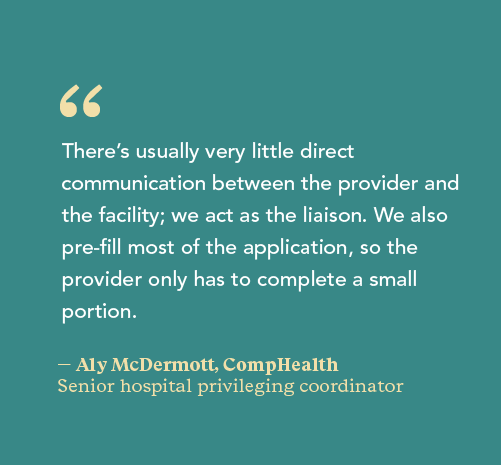
“There’s usually very little direct communication between the provider and the facility; we act as the liaison,” says Aly McDermott, senior hospital privileging coordinator for CompHealth. “We also pre-fill most of the application, so the provider only has to complete a small portion.”
You may still need to:
- Complete portions of applications
- Provide references
- Submit documentation
- Respond to follow-ups
But much of the coordination happens behind the scenes.
Like what you’re reading? More resources for locums NPs
How long the full process takes
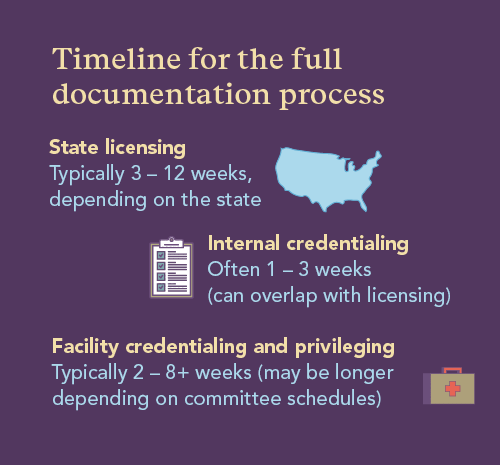
While every situation is different, here’s a realistic high-level timeline:
- State licensing: Typically 3 – 12 weeks, depending on the state
- Agency credentialing: Often 1 – 3 weeks (can overlap with licensing)
- Facility credentialing and privileging: Typically 2 – 8+ weeks(may be longer depending on committee schedules)
These processes don’t happen one after another; they happen simultaneously. That’s why timelines can feel unpredictable.
You might be waiting on:
- A state board for licensing
- A facility committee for privileges
- A reference to respond
All at the same time.
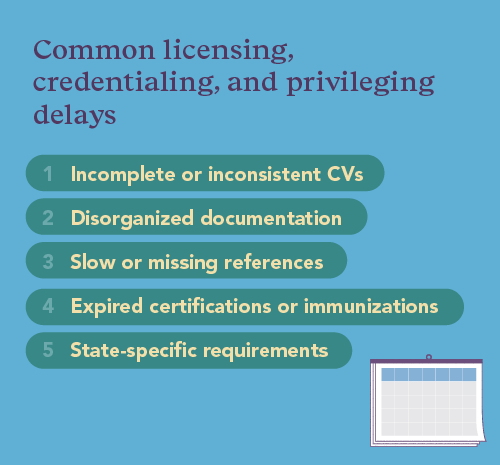
Common delays (and how to avoid them)
Even experienced NPs run into delays. The difference is knowing what to watch for.
1. Incomplete or inconsistent CVs
This is one of the biggest issues.
“The biggest issue we see is when a provider’s CV doesn’t match their application or isn’t up to date. That can slow things down significantly, especially if work history is missing or certifications are expired,” says Aly McDermott. “Having a thorough, accurate CV—and keeping all your documents like diplomas, certifications, and immunizations organized in one place—makes the process much faster and smoother.”
Make sure:
- All roles are listed
- Dates are accurate
- Nothing is missing
2. Disorganized documentation
Having to track down documents slows everything down. A simple fix is to keep a folder with licenses, certifications, immunization records, and diplomas ready to go.
3. Slow or missing references
References are one of the most common bottlenecks for locum NP credentialing. Facilities, and sometimes multiple teams, may reach out to them, so it helps to:
- Let references know in advance
- Choose responsive colleagues
4. Expired certifications or immunizations
Even small gaps can delay approval.
Double-check:
- BLS/ACLS
- TB testing
- Immunization records
5. State-specific requirements
Some states require:
- Supervision agreements
- Additional registrations
- Extra documentation not clearly listed upfront
These can catch NPs off guard if they’re not prepared.
How agencies support NPs through this process
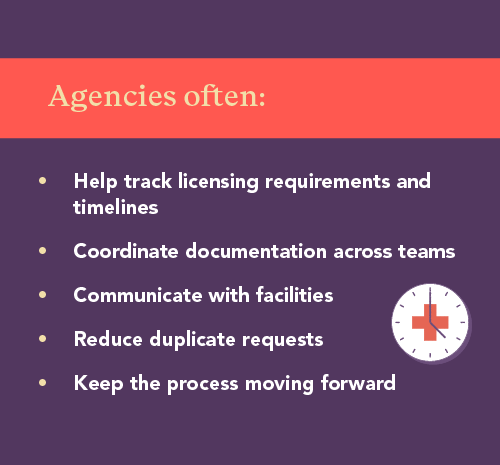
While each situation varies, agencies generally play a coordinating role across all three steps.
They often:
- Help track licensing requirements and timelines
- Coordinate documentation across teams
- Communicate with facilities
- Reduce duplicate requests
- Keep the process moving forward
In many cases, they act as the bridge between you and the facility. That coordination is what keeps everything aligned, especially when multiple processes are happening at once.
What to expect and how to prepare
If this process feels complex, that’s because it is. You’re navigating multiple systems—state boards, credentialing teams, and healthcare facilities—all with their own requirements.
But complexity doesn’t mean it’s unmanageable. Most of the heavy lifting happens behind the scenes.
Your role is to:
- Stay responsive
- Keep your information accurate and up to date
- Be prepared with documentation
- And most importantly, give yourself time
Once you go through the process the first time, everything becomes more familiar—and faster.
For many nurse practitioners, that initial learning curve is what opens the door to the flexibility, variety, and control that locum tenens can offer.