
Locum tenens can be a great option for physicians looking to supplement their income, apply their skills in new settings, or explore alternative career paths. An estimated one-third of physicians are currently working locum tenens or have done so in the past, yet many physicians may not be fully aware of the opportunities available through locums. Read on for your primer on locum tenens.
What is locum tenens?
Think of locum tenens physicians as medicine’s substitute teachers. From the Latin phrase meaning “to hold the place of,” a locum tenens provider is a physician who fills in temporarily for another. What began in the 1970s with the purpose of providing physician staffing services to medically underserved areas of the western United States has expanded to a thriving industry and an important option for healthcare facilities nationwide to maintain coverage, fill staffing gaps, and expand specialty offerings.
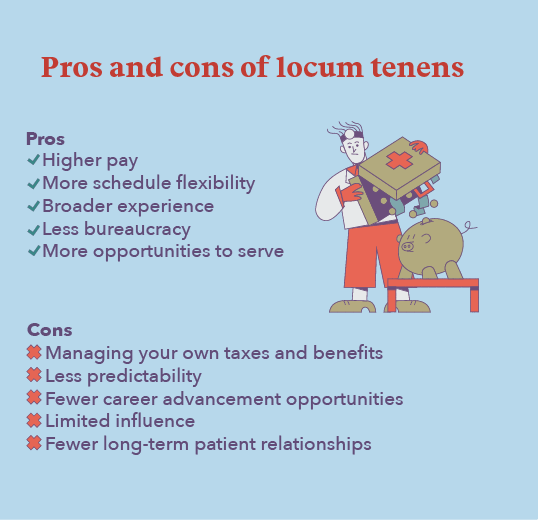
What are the pros and cons of working locum tenens?
Higher pay but no employer-sponsored benefits
Many physicians say one of the top benefits of locum tenens is the higher hourly or daily pay. However, working as a 1099 independent contractor requires additional work, including handling your own withholding and filing quarterly taxes. The downside is that you need to arrange for your own health, dental, and supplemental insurance and manage your own retirement contributions, benefits often provided by an employer.
How much does locum tenens pay? Check your specialty

Emergency medicine physician Dr. Russ Reinbolt says, “There are pluses and minuses, but I would say on par, locums is better from a financial standpoint, definitely from a lifestyle standpoint, and, in my opinion, a practice setting standpoint. You’re typically paid more—significantly more—but from that, you have to pay things yourself. I think the positives far outweigh the negatives of being a locum doc. For me, it’s a no-brainer.”
Orthopedic surgeon Dr. Sonya Sloan gives this advice, “I would definitely recommend being on top of your taxes because you’re a 1099 employee. I wish someone had explained taxes and finances to me the first three years, when I made quite a bit of money and paid a lot of taxes.”
More flexible but less predictable
A locum physician can choose where, when, and even how often they work. The flexibility of locums gives you more control over your schedule and supports a better work-life balance, but it also lacks the predictability of a traditional career.
ENT Dr. Benjamin Feldman says, “One of the beautiful parts about locums is that it does facilitate a very nice work-life balance because you can have a lot more autonomy over your schedule. In other words, if you know in advance that your spouse has a busy month at work and you need to be more available, you can engineer your schedule that way with maximum flexibility.”

However, family medicine physician Dr. Harshal Patel comments, “The hard part about flexibility is just the irregularity of income. That’s the most challenging.”
Broader experience but fewer career advancement opportunities
A locum physician has the advantage of broadening and diversifying their skill set by working with different patient populations, varied clinical approaches, and new technologies. There is a steeper learning curve with locums that supports clinical growth. However, if you choose locum tenens as a full-time career, the trade-off is that there are fewer opportunities for career advancement within an organization.
Orthopedic surgeon Dr. Nicholas Kusnezov says, “Locums offers the potential to selectively diversify and control the scope of your practice and thereby increase your professional experience and skill set.” On the other hand, an up-and-coming orthopedic surgeon who stays with just one employer “may end up in a practice that confines you to a certain ‘niche.’ You might be the orthopedic ‘shoulder’ guy, stuck filling your schedule with procedures you may not be passionate about.”
“Medicine is a dynamic, ever-changing field that is advancing at an accelerated pace. Locums will expose you to a variety of different settings, medical staff, and novel concepts in diagnosis and management, which will in turn keep you sharp, relevant, and up to date with the state of the art,” he says.
“The classical and traditional way of practicing medicine isn’t the way everyone does it,” adds OB-GYN Dr. Derrick Barnes, “You can get refreshed by changing your environment and seeing how other people practice. Maybe you hate it, and then you don’t ever need to think about it again, or maybe you love it and want to incorporate it into your practice.”
Less bureaucracy but limited influence
A locum physician does not have to attend meetings, perform as many administrative tasks, or deal with bureaucracy—which can be a huge help in reducing burnout—but that also means they have little say in decision-making and can feel like an outsider.
Anesthesiologist Dr. Noel Lumpkin says, “One of the problems in medicine these days is that the majority of our jobs are no longer in medicine itself. It’s all of the extrinsic things—the meetings, the new rules, the administration—and those add to the fatigue. With locum tenens, I always joke that I haven’t been to a meeting in over 11 years, and I haven’t missed that one bit.”

General surgeon Dr. Jon Bowersox adds, “The positive is that you don’t get involved in hospital politics. The negative is that you’re not fully part of the team at the hospital.”
Serving where needed but fewer long-term patient relationships
Locums offers physicians the opportunity to serve in underserved communities, which can be rewarding and fulfilling. However, many miss the long-term patient relationships. Some doctors take ongoing locums assignments that can last for years and develop strong relationships over time, but that’s the exception rather than the rule.
Emergency medicine physician Dr. Rip Patel says his rural patients “were immensely grateful that somebody would leave their home and their big city to come to their rural community to help them. When these communities get people who are well trained and passionate about providing that service, there’s just an immense amount of gratitude.”
Pediatrician Dr. Trevor Cabrera says, “I’ve gotten to know patients, and then it’s hard to leave, to be someone that’s just a temporary person. You make relationships, and if you’re doing it purposefully, you’re going to care about people.”

Locum tenens can work at all stages of a physician’s career
Locums can be an exciting catalyst for new opportunities, no matter the stage of your career. Neurologist Dr. Andrew Wilner, author of The Locum Life: A Physician’s Guide to Locum Tenens, speaks to the opportunities available to physicians at each stage of their career.
Early career physicians
“Physicians just out of residency have discovered locum tenens is a great way to test out different facilities in new geographic locations. A new attending physician’s priorities are different than seasoned physicians. They want to refine clinical skills, quickly pay off student loans, and take the time to scrutinize employment options before signing a long-term contract—all of which can be accomplished with locum tenens.”
Finishing up residency? Explore your options
Mid-career physicians
“Mid-career physicians often employ locums to augment their income. There may be life circumstances that destabilize a household budget—new home, student debt, children—but working locums can help restore financial balance when cash flows out faster than it trickles in. More and more mid-career physicians wishing to leave medicine are exploring non-clinical careers. Locums can be a bridge to a non-clinical job by providing an income stream until the new venture takes off.”
Late-career physicians
“I consider myself to be in the late-career physician category. At this stage of my career, I feel I’m able to preserve my physician identity by working locums if I decide to leave my full-time academic position. Locum tenens is also great for physicians who just aren’t ready to fully retire. Patients and facilities alike will also benefit from skilled, experienced physicians, and you’ll be able to continue doing what you love.”
Nearing retirement but not ready to hang up the stethoscope? Family medicine physician Dr. Marye McCroskey worked locums in Hawaii to keep practicing and travel the globe with her husband. Hear her story:
Reasons to work locum tenens
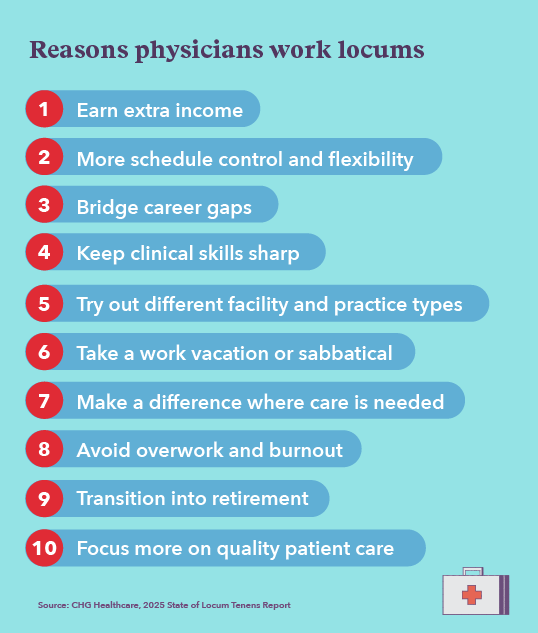
Physicians choose locums for a variety of reasons at different points in their careers. According to CHG’s 2025 State of Locum Tenens Report, these are the top 10 reasons physicians work locums:
- Focus more on quality patient care.
- Earn extra income.
- More schedule control and flexibility.
- Bridge career gaps.
- Keep clinical skills sharp.
- Try out different facility and practice types.
- Take a work vacation or sabbatical.
- Make a difference where care is needed.
- Avoid overwork and burnout.
- Transition into retirement.
Ways to work locums
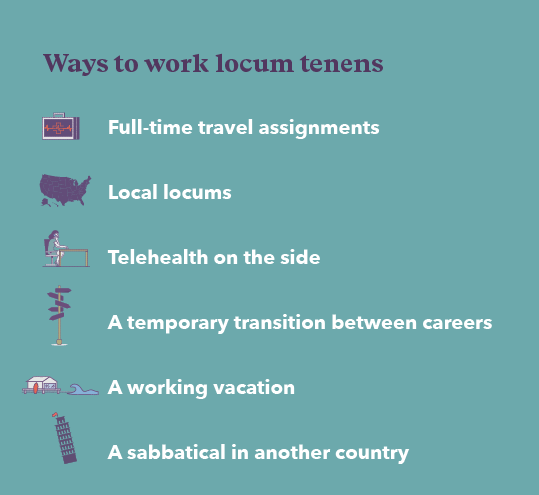
Locum tenens is often thought of as traveling all over the country from one assignment to another, but this isn’t always the case. Locum assignments can be as short as a weekend and as close as your own town. Some physicians work long-term locum assignments or return again and again to the same facility for months or even years. While many physicians work locum tenens as their full-time career, 47% work locums on the side or for brief periods during transitions. Here are some ways physicians work locum tenens:
- Full-time travel assignments
- Local locums or telehealth on the side
- A temporary transition between careers
- A working vacation
- A sabbatical in another country
Interested in telehealth? Read the locums guide
International locum tenens
For the adventure-seeker, international locums assignments can be a great way to experience another country and culture while providing needed care. Many locum physicians use this unique opportunity to live like a local and travel extensively before, during, and after their assignment.
With international assignments come important questions and considerations to evaluate in advance, including:
- How long can I commit to living internationally?
- Do I have family who will join?
- If I have pets, will I bring them or leave them at home?
- Am I comfortable living in new, unique cultures?
- Does living like a local sound exciting?

Emergency medicine physician Dr. Joseph Leary had a couple of months between jobs and took a locum tenens assignment in the Caribbean to cover the gap. “For me, it wasn’t about the money. It was an opportunity to expand, broaden my horizons, and connect with physicians from other countries.”
For more information and tips on a successful international locums assignment, read Global Medical’s beginner’s guide to international locum tenens.
The logistics of working locum tenens
Locum tenens doctors work as independent contractors
As independent contractors, all expenses related to taxes, insurance, and retirement are assumed by the provider. Taxes are not automatically taken out of a locum physician’s compensation, and they are responsible for making quarterly estimated income tax payments.
Learn the difference: W-2 vs. 1099 for locums
Neurologist Dr. Simrah Singh did the research and due diligence to ensure her financial affairs were carefully in order.
“I looked at it as an opportunity to learn,” she says. “As far as health insurance, you can go on the healthcare marketplace and buy health insurance yourself, which is what I do. You can pick high-cost plans and low-cost plans, depending on your needs, and write them off on your taxes if you’re an independent contractor. And you know, it’s really not hard. It just takes a little more time. I also use an accountant and just have them do it for me.”

Seasoned locum tenens physicians recommend working with an accountant to understand and take advantage of the tax benefits available to independent contractors, including deducting business travel, business meals, continuing medical education (CME), equipment, lodging, and home-office expenses.
Locum taxes deep dive: A locum physician’s tax guide
Managing your own finances, benefits, and business decisions may deter some doctors from choosing to work locum tenens. Hear how emergency medicine physician Dr. Russ Reinbolt navigates the financial and logistical side of locums.
Locum tenens pay
Like any profession, there are many variables that influence locum tenens pay. Rates may vary by specialty, location, season, shift type, and patient load. An agency can help negotiate pay, as well as shift preferences, housing details, and per diem allowance.
You are paid directly by the locum tenens agency, typically weekly or bi-weekly, depending on the agency.
In addition to the hourly or daily rate, the locums agency will generally cover additional expenses, such as housing, transportation, medical malpractice insurance, and costs associated with licensing, credentialing, and privileging.
Get all the details: How does locum tenens pay work for physicians?
Licensing, credentialing, and privileging
To work a locum assignment, you will need to be licensed in the state where you will be practicing, credentialed with the health system to verify your credentials, and privileged with the facility to be able to perform procedures. As with anything else in healthcare, there is a lot of paperwork involved, but you don’t have to do it on your own. Most agencies provide robust support to make the credentialing process easier.
Using a locum tenens agency
While providers have the option to research and secure locum tenens positions on their own, experienced locums emphasize the benefits of working with a locum tenens agency, especially when they are starting out or working part time.
“If you’ll end up working locums part time, I would say working with an agency is nice because they make sure everything is set up on time, such as travel and housing arrangements. This way, you’ll be all set before you start to work on your first shift,” says emergency medicine physician Dr. Rip Patel.
Pro tip: If you know someone who works locum tenens, ask them to refer you to their favorite agency. You may both be able to get a referral bonus through programs like these:

Tips for finding an ideal locum tenens agency fit
When it comes to finding an ideal locum tenens agency fit, look for an agency that will support you in both sourcing and successfully completing your assignment.
Questions to consider when choosing a locum tenens agency and recruiter:
- Are there enough job opportunities to offer a pick of assignments?
- Do I have flexibility to work as much or as little as I want?
- Am I comfortable with this recruiter?
- Can I build a long-term relationship with this recruiter?
- Does this recruiter understand my needs and put my interests first?
Dr. Patel encourages prospective locums to select an experienced, established locum tenens agency and recruiter.
“Going with an agency that is experienced and an agent who’s experienced makes a world of difference,” he says.
In today’s competitive locum tenens landscape, reputation matters—and so does the agency behind it. This video explores how the right agency partnership can streamline logistics like licensing, credentialing, and housing.
Interested in working with an agency? View our comparison chart
Working with an agency
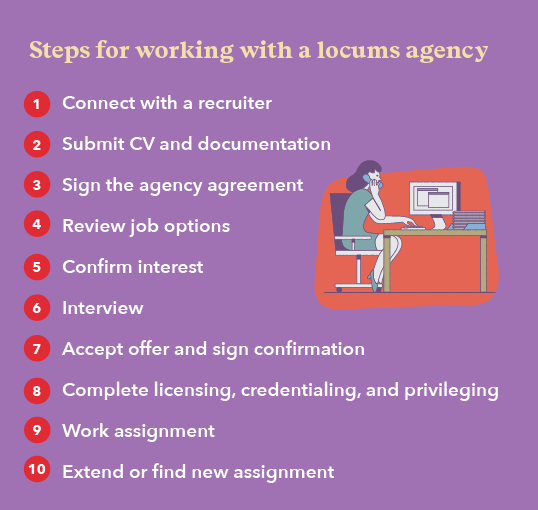
Getting to know you
Every agency works differently, but generally the process starts with a phone call. Your recruiter will want to get to know you so they can find the best assignment for you. They’ll be interested in:
- Your clinical experience
- Your current licenses and certifications
- How often you want to work
- Your preferred shifts and hours
- Your availability
- Where you’d like to practice
- How much you want to earn
- Your hobbies and lifestyle
Finding and accepting a job
Once you’ve decided to work with a recruiter, you’ll send them your CV, licenses, and certificates, so they can look for job matches for you. Once you identify a fit, your recruiter will present you to the facility. A good recruiter will help with your CV and prep you for an interview.
If the facility wants to work with you, your recruiter will negotiate pay, assignment details, and any negotiable points in the contract that are important to you. You will receive a confirmation letter outlining all terms, which you must sign to accept the assignment.
Locum tenens assignment 101: A checklist for locums success
Preparing for an assignment
Before your assignment, your agency will work with you to complete licensing (if needed), credentialing, privileging, and any other paperwork, and to coordinate travel and housing (if needed). A good agency will also offer malpractice with tail coverage to protect you past the assignment dates.
Your onboarding at the new facility will most likely include an orientation and EMR training. Then you begin your assignment. When you work with an agency, your paycheck will come from the agency, not the facility where you work, and any issues that arise can be addressed through your agency.
What’s next?
At the end of your assignment, you may have the option of extending, or your recruiter can look for a new assignment for you.
How to choose your ideal locum tenens assignment
When it comes to choosing a locum tenens assignment, there are several primary factors to consider:
- Location
- Pay
- Case mix
- Patient volume
- Time commitment
In addition to these considerations, experienced locum pediatrician Dr. Trevor Cabrera encourages providers to think outside the box and ask what he considers to be the most important question:
“My favorite question to ask is why the facility needs a locum provider in the first place,” he says. “If it’s for a simple maternity/paternity leave or a staff member that has transitioned to another job for a personal reason, I’m less dissuaded. If there is a history of running through one provider after another, I am very wary.”
Dr. Cabrera also likes to speak with current locums at the facility, if possible, for additional perspective on the facility and assignment.
Ready for your first assignment? 5 tips for your locum job search
Tips for locums success
Locums can be an exciting career path for physicians and offer new and uncharted opportunities, but with the new can also come the uncertain and even overwhelming. Consider these tips from seasoned locums to set yourself up for locum tenens success.

1. Communicate your preferences
Infectious Disease physician Dr. R.K. Devlin underscores the importance of knowing what you want and clearly communicating your preferences. “The first step to ensuring a positive locum tenens experience is to clearly communicate your practice and travel preferences to your recruiter. Being honest about the type and amount of work you want to do is imperative, as those choices allow your recruiter to match you with a job opportunity that best meets your expectations.”
2. Be open to new ways of doing things
Dr. Devlin also encourages new locums to approach the experience with an open mind and curious nature. “While there is always a bit of anxiety when navigating a new environment, I mostly find locums work to be both interesting and educational. I like learning about patient care in different medical settings and establishing new friendships.”
3. Get organized, especially your paperwork
There are many moving pieces to keep organized, and the paperwork alone can, at times, feel cumbersome. Dr. Marye McCroskey shares tips on keeping the locum tenens paperwork organized for newcomers and veteran locums alike. “You will have paperwork to complete for each locums assignment, but it doesn’t have to be painful if you have all the information you need at your virtual fingertips. And the opportunities that locums provide are well worth the work!”
4. Be nice to colleagues and support staff
Among all his advice for a successful experience, Dr. Rip Patel prioritizes one simple rule for locums success above all else: “Be nice. Seriously. It’s really just that simple. Be nice to your staff, be nice to your colleagues, and try your best to be nice to consultants. Sometimes the latter can be difficult, especially—as I have found in rural localities—where standards of practice might be different from your own. But simply put, pick your battles. When you remain committed to this mindset, staff will generally go out of their way to help you, assist you in navigating the system, and make your shifts run smoothly.”
Myths about locum tenens
Myth: Locums work is unstable
Good agencies have consistent, year-round demand. It is possible to work back-to-back assignments or even extend your assignment for long-term stability.
“There is a vast amount of opportunities. and it allows me to be a free agent and pick and choose the assignments I want,” says family medicine physician Dr. Colin Zhu.
Myth: Locums involves a lot of travel
Local locums is a growing trend. In fact, 58% of physicians who work locum tenens do so locally. Many specialties, like psychiatry and urgent care, have telehealth options that don’t involve travel at all.
Family medicine physician Dr. Jordan Salmon shares, “I was looking for some opportunities to boost my income, and that’s where telemedicine popped up. I was able to be at home or in my office and take calls in between patients. I was allowed a lot more flexibility, and it allowed me to stay closer to home and be present for my patients.”
Myth: The staff treat locums like outsiders
Most facilities are happy to have help and welcome locums with camaraderie and support. If you go into a locum assignment with an attitude that you’re there to learn and help instead of inform and control, you can have a rewarding experience.
“For the most part, people are very happy to see you because there’s a shortage and you’re the relief crew,” says family medicine physician Dr. Karen Kurlya.
Pediatric neurologist Dr. Kellie Sweet says, “The staff want you to be there because you’re supporting them and their work. Every place I’ve been, the staff has been really helpful and want me to succeed where I am.”
Myth: Only desperate hospitals hire locums
While locums may have once been used as an emergency stopgap, more and more facilities are using them strategically to plan for coverage and expansion. In the last five years, requests for locum tenens have more than doubled, and that trend is only expected to continue.
Underserved areas that are desperate for locums help offer opportunities for physicians to serve and share their expertise. Some locum physicians seek those kinds of opportunities because of the impact they can make.
OB-GYN Dr. Derrick Barnes has “an interest in rural and underserved medicine. I can target an assignment that has primarily rural or underserved patients. When you’re in these rural settings, you have to practice in a very different mindset. There may be skills I have to really dig back into to help me get through. I’m also not only serving patients who are underserved, but I may be helping a doctor who’s totally overworked and just needs a break.”
Family practice physician Dr. Derrick Barnes shares how locum tenens can be rewarding for physicians interested in helping support smaller hospitals and doctors who need some help. And gaining extra skills is another bonus.
Myth: Locums is not a real career path
Many physicians built their entire career on locums because of the benefits of high earnings, less burnout, greater flexibility, and more autonomy.
“I wanted to be on my own. I was looking to be my own boss and get the opportunity to travel,” says Dr. James Stone. “Once I decided to go into being a locum tenens physician, I just went for it and realized I needed to get out and make friends in the industry, and then work as hard as I could. I’ve said yes to practically every assignment I’ve been offered.”
Myth: Locums is only for new doctors or retirees
Physicians turn to locums throughout their careers for myriad reasons, whether that’s to boost their income, mitigate burnout, balance life as a parent, transition between jobs, or many other reasons as varied as physicians themselves. Locums isn’t always a long-term career path, but it is a strategic option for many physicians and is available at any stage of a physician’s career.
“There are a lot of ways that locums can be used,” says emergency medicine physician Dr. Jim Dahle. “It can be used for your entire career, but I think a lot of people use it as a side gig. They have a regular job and take some time off from it or do locums on weekends to boost their income or try something new.”

Internist Dr. Paymon Kayhani says, “Locums is magnificent in that it is not one thing to all people. It’s flexible. It’s malleable. And it can be effective at various times in a physician’s career.”
Do you have a question about locum tenens that wasn’t answered by this article? Email us [email protected]