
Locum tenens has long been part of the healthcare workforce, but who chooses this type of work and why has often been shaped by assumptions rather than data.
To better understand today’s locum workforce, Weatherby Healthcare conducted a national survey of physicians across specialties and career stages for its 2026 Locum Tenens Physician Report. The findings offer a closer look at how physicians are learning about locums, who works locum tenens jobs, and the different purposes locums can serve throughout a medical career.
How doctors are talking about locums: A perceptible shift
If it feels like more physicians are talking about locum tenens than they were a few years ago, you’re not imagining it.
Data from the 2026 Locum Tenens Physician Report suggests that awareness of locums is increasingly spreading through physician networks rather than traditional recruiting channels. In 2019, 58% of physicians said they first learned about locum tenens work through a staffing agency. By 2024, that figure had fallen to 33%.
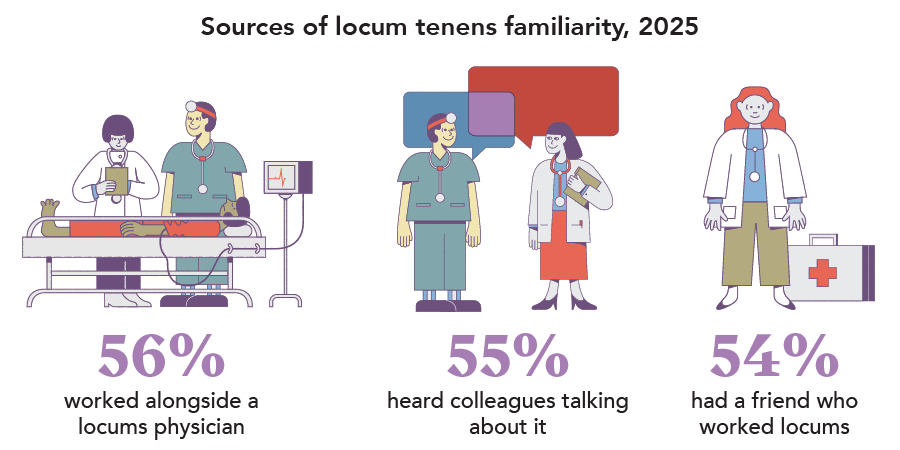
Instead, physicians are learning about locums from the people they work with every day. More than half say they’ve discovered locums by working alongside a locum tenens physician (56%), hearing about it from a colleague (55%), or talking with a friend who has worked locums (54%).
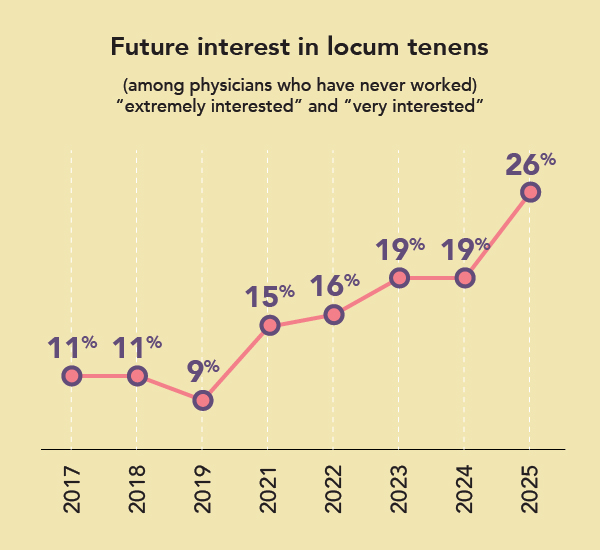
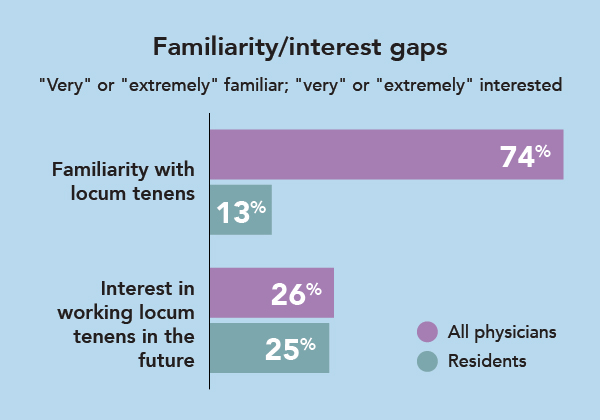
Interest appears to be growing alongside that visibility. Today, 26% of physicians describe themselves as very or extremely interested in working locum tenens, a 7% increase from the previous year and the highest level recorded in the past decade.
The data suggests that locums is shifting from something physicians hear about to something they see in practice. And as locums becomes a more visible, peer-validated career choice, assumptions about who participates and why may be changing as well.
So who exactly are these physicians, and what’s driving them toward locums? The data may surprise you.
Doctors’ perspectives: Why they choose locums
The physician working locums looks a lot like you
Today, 14% of U.S. physicians are actively working locum tenens. That’s a meaningful share of the physician workforce, and the demographic profile of those physicians looks remarkably similar to the profession as a whole.
Gender participation in locum tenens closely mirrors the broader physician population. And physicians with children under 18 participate at nearly identical rates as those without children, dispelling the common myth that locums is incompatible with raising a family.
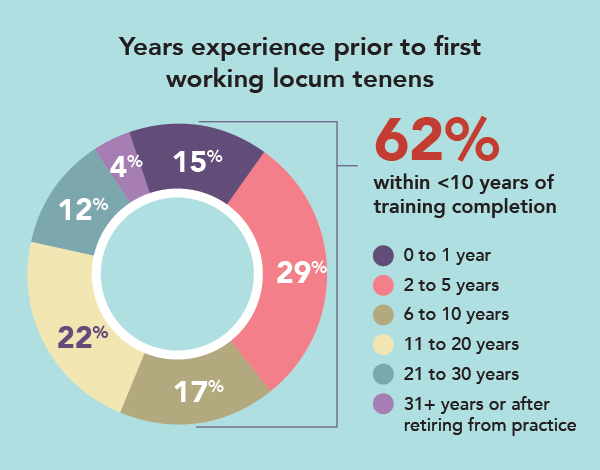
Career stage tells a similar story. While locums is sometimes associated with physicians nearing retirement, nearly two-thirds (62%) of physicians who have worked locums started within their first 10 years of practice.
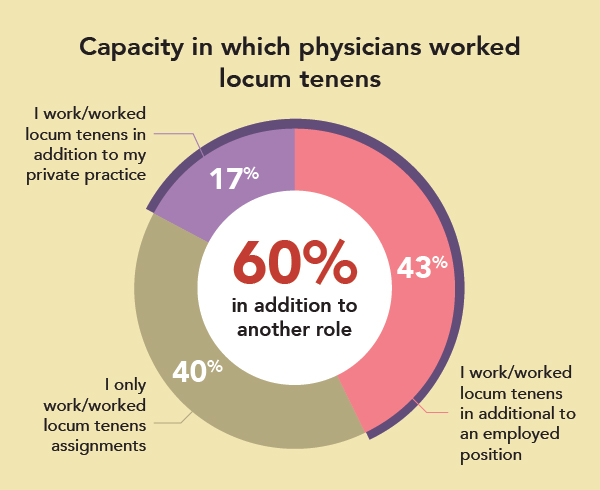
Further, the findings challenge the idea that physicians must choose between a traditional role and locums work. Sixty percent of locums physicians use it alongside another professional role, whether that’s a permanent position, private practice, academic appointment, or another clinical commitment. The remaining 40% use locums as their primary practice model.
The demographic picture helps explain who works locums. The more interesting question is why, and that answer often changes over the course of a career.
Read the guide: Working locum tenens with a family
Where you are in your career shapes how locums works for you
Physicians engage with locums in different ways throughout their careers. The survey findings show that the motivations, benefits, and opportunities associated with locums often shift as physicians move from training to practice to retirement planning.
Early career: Financial pressure, information gap
New physicians are entering practice under enormous financial pressure. The median medical school debt for the Class of 2025 reached $215,000, and changes to federal loan forgiveness programs threaten to narrow some repayment pathways. Against that backdrop, locums can offer a way to supplement income, accelerate debt repayment, or gain financial flexibility early in a career.
Yet despite those potential benefits, many residents know relatively little about locums. While residents report nearly the same level of interest in locums as the broader physician population—25% say they are very or extremely interested in locums—only 13% say they are familiar with how it works. For many physicians who eventually pursued locums, timing was a factor: half report they had already accepted a full-time position before they realized locums was an option.
What many seasoned locum tenens physicians understand—and many residents may not yet realize—is that the value of locums extends beyond compensation. Locums can function as a “try before you buy” approach to career planning.
“With locums, I was able to explore what kind of practice I actually wanted—the type of colleagues I’d enjoy working with, the workload I could handle, the autonomy, and which administrations I worked well with,” said hospitalist Dr. Trung Tran. “It let me try out different hospital systems, different nursing staff, and different practice environments to figure out what I liked and what I didn’t, and then use all of that to guide my search for a permanent position.”
Nearly six in 10 physicians who have worked locums say it’s an effective way to evaluate practice settings before accepting a permanent position, yet only 11% of residents view it that way. The gap points to a disconnect between potential interest in locums and an understanding of how it can be used early in a physician’s career.
The pros and cons: Working locums right out of residency
Mid-career: When flexibility becomes a necessity
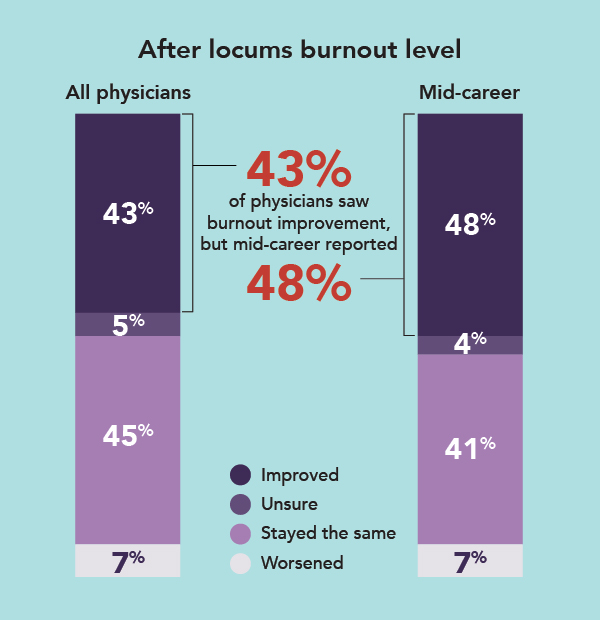
By mid-career, many physicians find themselves struggling to manage an unsustainable status quo. Physicians in this stage reported the highest levels of occupational strain and burnout in the survey, reflecting the competing pressures of patient care, administrative responsibilities, practice economics, and family life.
At the same time, they are the group most likely to report improved well-being after starting locums work. Nearly half (48%) say their well-being improved, the highest percentage of any career stage.
“The word I’d use is liberating. In my previous job, I was doing three to four hours of EMR work every night, rounding every day including weekends—I was exhausted. Burnout is a real thing,” said urologist Dr. Martin Rifkin. “Locums has given me new energy. When I leave an assignment, I’m done. I have at least a week to recuperate, explore other things, pick up new hobbies, travel. As doctors, we’re not used to that; we’ve been going continuously for years. But it’s happening, and it’s been transformative.”
Financial and family considerations often reinforce the appeal. With Medicare reimbursement declining in real terms over the past two decades, many physicians use locums to supplement practice income, particularly those in private practice. Mid-career physicians with children are also more likely to work locums alongside another professional role, with locums functioning as a way to create greater financial and scheduling flexibility.
“Contrary to what I imagined, the on-the-ground private practice job actually gave me less family time than a job where I travel and live in a different community for seven to ten days at a time. I was pleasantly surprised by that,” said Dr. Benjamin Feldman, an otolaryngologist. “Once you get done with your locums obligation, you can have up to two or three weeks off to have good quality time—to support your spouse and be there for your children. You can engineer your schedule with maximum flexibility.”
Whatever their initial motivation to pursue locums, physicians at this career stage are more likely than any other cohort to continue working locums or return to it after time away.
How do they compare? Locum tenens jobs vs. permanent positions
Late career: Practicing differently, not stopping
As physicians approach the later stages of their careers, many begin thinking less about advancement and more about how they want to practice in the years ahead.
Most physicians approaching retirement aren’t looking to stop practicing altogether. Instead, they want greater control over when, where, and how much they work. Nearly two-thirds (63%) say they would prefer to reduce their workload rather than leave medicine entirely.
“I’m only 60. I’m not ready to retire. I still feel young, I’m in good shape, and I’ve got several good years left in me,” said family medicine physician Dr. Jeffrey Culpepper. “Locums has been a great transition between full-time medicine and retirement. The stress is lower. You go in, see your patients, interact with the staff, and then you go home. You actually have a life outside the office.”
Locums can provide a bridge between full-time practice and retirement. Physicians with more than 20 years of experience are the most likely to accept assignments across the country, helping fill gaps in communities with ongoing physician shortages. And even after leaving full-time practice, many physicians plan to keep their licenses active for several years, with nearly one-third saying they would use that time for locum assignments.
“I look at locums as retirement with interruptions,” said Dr. Jeffrey Miller. “You work hard, you’re in it, and then you sign out and you’re off for a week, ten days, two weeks. During that time, you’re basically retired. You get to experience retirement without committing to it. I don’t think of locums as a bridge to retirement. I think of it as prolonging your career while avoiding retirement, but still getting to live what retirement feels like. Honestly, I haven’t even thought about retirement since I started doing this. I probably would have retired already if this wasn’t available.”
Planning for retirement: How to plan as a locum
Locums as a career lever
Regardless of career stage, one pattern holds across the data: Physicians who try locums tend to stick with it or come back to it. Nearly eight in 10 current locums physicians say they are very or extremely likely to continue working locums, and more than a quarter (28%) of physicians who have stopped say they are very or extremely likely to resume in the future. Locums often functions as a lever physicians can pull when their needs, priorities, or circumstances dictate.
That staying power is reflected in the length of time physicians spend working locums. Across specialties, the average locums tenure is six years, increasing to seven years in primary care and eight years in emergency medicine.
Perhaps most telling is how physicians view the timing of their decision. While nearly one-third wish they had started sooner, 69% say they began working locums at the right time for them. These data underscore that locums often serves a specific purpose at a specific point in a physician’s career.
Locum tenens serves a different purpose at every stage of your career
The survey findings challenge many of the assumptions physicians have historically held about locums. There is no single profile of a locum physician, no typical career stage for getting started, and no universal reason for choosing this type of work.
What emerges instead is a picture of physicians responding to the realities of modern medical practice, from educational debt and reimbursement pressure to administrative burden and evolving priorities outside of work. Across career stages, physicians expressed a desire for greater control over time, income, workload, and career direction.
Physicians use a variety of approaches to create that flexibility, and locums is one of them. The survey findings show physicians using it to explore practice settings, supplement income, reduce physician burnout, ease into retirement, and address changing career priorities over time. How long they use it—and whether they return to it later—depends on what they need from their careers at a given moment.
If you’re evaluating your own options, the most useful question may not be whether locums is right for you. It may be whether it could help address a challenge or goal you’re facing right now. For a deeper look at how physicians across specialties and career stages are answering that question, explore the full findings from the 2026 Locum Tenens Physician Report.
See how locum tenens works in practice—for free.