ASCO’s workforce report shows oncologist supply isn’t keeping pace with growing cancer care needs. If you’re an oncologist considering locum tenens, that gap works in your favor: you can go where the need is greatest and still decide when, where, and how you want to practice. Here’s what we’ve learned from oncologists who’ve done exactly that.
Here’s what we’ll cover if you’re thinking about locums:
- Why medical oncologists choose locums
- What a locums assignment looks like
- How continuity of care happens in locums
- Locums in your career stage
- Benefits and trade-offs
- Logistics (malpractice coverage, taxes, housing, and travel)
Why do medical oncologists choose locum tenens?
Oncology ranks among the highest of any physician specialty for interest in locums, and the reasons go beyond pay:
- Schedule control: More say over when and how much you work, depending on the assignment.
- Burnout recovery: Rising patient volumes and administrative load are two of the most common reasons oncologists cite for burnout. In an American Medical Association’s workforce survey, hematology-oncology ranked third-highest of any specialty for burnout. Changing your volume, administrative load, or schedule, even temporarily, can be enough of a reset.
- Income: Locums can add income alongside another position or become a bigger part of your practice. Compensation varies by location, demand, schedule, and assignment requirements.
- Exploration: A way to test a practice, a health system, or a part of the country before you commit long-term.
- Autonomy: Keep practicing oncology without every part of the job feeling like administrative overhead and have more say over how your assignments are structured.
- Impact: Rural and underserved communities are more likely to be without an oncologist at all. A locums assignment can mean being the one who’s there for someone who needs care now.
What a locum oncology assignment actually looks like
Locum oncology assignments range from a defined outpatient clinic panel to inpatient consult work, to covering an infusion center, and the shape of the work changes a lot depending on which one you’re in. Patient volume, call expectations, even the EMR you’re charting in, can look completely different between two assignments 20 miles apart.
Before you accept an assignment, ask specifics that get at what the facility actually needs, not just the specialty and location, so you can gauge whether it’s a good fit:
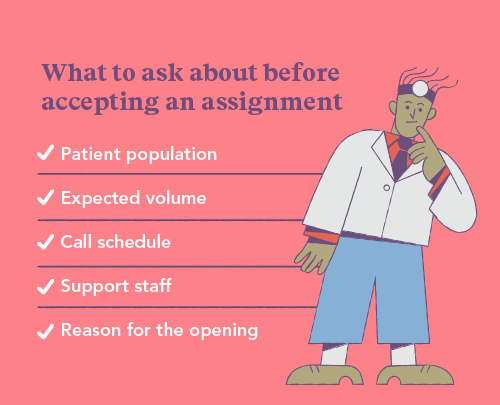
- Patient population
- Expected volume
- Call schedule
- Support staff
- Reason for the opening
For more on oncology assignment types, schedules, and pay: Locumstory’s trends by specialty tool
How do locum oncologists ensure continuity of care?
How much continuity you can offer as a locum oncologist usually comes down to what the facility needs.
Sometimes you’re stepping in for an oncologist who’s on leave or has recently left. Your job there is to keep patients’ care moving through the transition. You may not have years to build the relationship, but you can still be a steady presence during an uncertain stretch.
Other times, a facility has gone without an oncologist for months, sometimes longer. In that situation, you’re not disrupting continuity. You’re restoring it: giving patients access to someone who can evaluate their condition, manage treatment, answer questions, and keep their care moving.
You don’t have to wait until you’re weighing an assignment to think about continuity. Ask about the situation before you accept:
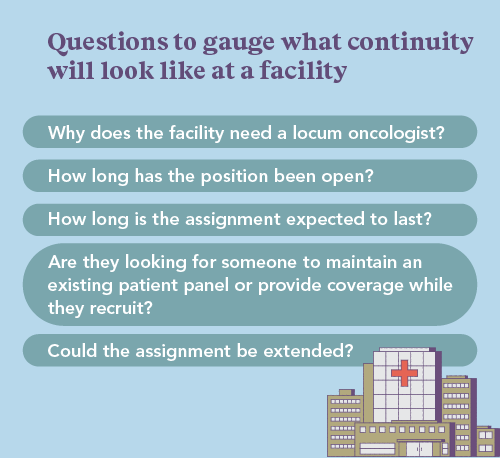
- Why does the facility need a locum oncologist?
- How long has the position been open?
- How long is the assignment expected to last?
- Are they looking for someone to maintain an existing patient panel, or provide coverage while they recruit?
- Could the assignment be extended if both sides are interested?
The right questions can help you find an assignment that fits not just your schedule and career goals, but the kind of patient care you want to provide.
Dr. Betsy Connelly, a medical oncologist who’s worked locum assignments in northern Maine, Wyoming, Montana, North Dakota, and Hawaii since 2021, has seen both versions of this. At one site in northern Maine, she arrived to find a facility that had gone roughly two years without a permanent oncologist. In Hawaii, she says, the situation is similar today. “It’s not good in oncology to constantly have different providers, but sometimes there’s really no choice,” she says. “I’m pretty straightforward with patients. I tell them who I am, why I’m there, and when I’ll be there. And if we can arrange follow-up so I’m the one seeing them for a while, I do that. They know somebody is carrying them.”

She also points to a continuity benefit that’s easy to miss: a locum coming in fresh has to learn the whole case from the beginning, which can mean a second set of eyes on a treatment plan that’s been running for years.
For some oncologists, filling in looks like stepping in briefly during a transition. For others, it means becoming a reliable presence for patients who’ve been waiting for one.
Locum tenens for oncologists by career stage
You can start locums at any career stage, from early-career physicians exploring their options to experienced oncologists gradually stepping back from full-time practice.
Early career
For physicians coming out of fellowship, locums can be a way to try different practice settings before you commit to a permanent position. You can experience community oncology, hospital-based practice, or a new part of the country while you build clinical independence.
The trade-off is that you’re still getting used to practicing independently. A new EMR, an unfamiliar care team, and different workflows add another layer of adjustment, so ask about orientation and clinical support before you accept an assignment.
Mid-career
For established oncologists, locums can be a way to change how you practice without leaving medicine altogether.
That might mean fewer administrative responsibilities, a different patient volume, more schedule flexibility, or work outside a permanent position. Some physicians also use locums to see how another health system or community operates before making a bigger career move.
Late career
For some physicians, locums offers a gradual path toward retirement. Instead of stopping clinical work all at once, you might step away from leadership or administrative duties while continuing to practice on a schedule that works for you.
Dr. Connelly, who has retired from full-time practice, keeps her own commitments to three months at a time. “I’m not a regular schedule kind of person, at least not in retirement,” she says.
Part-time, alongside another job
You don’t have to leave a permanent position to try locums. Some physicians take it on as supplemental work, fitting assignments around their existing schedule. If that’s you, check your employment agreement first. It may restrict moonlighting, outside employment, non-competes, or where you can practice.
Benefits and trade-offs of locum tenens oncology
What are the downsides of locum tenens?
Locums can offer flexibility, income, and variety, but it’s not simply a better version of permanent employment. The tradeoffs are different, not smaller.
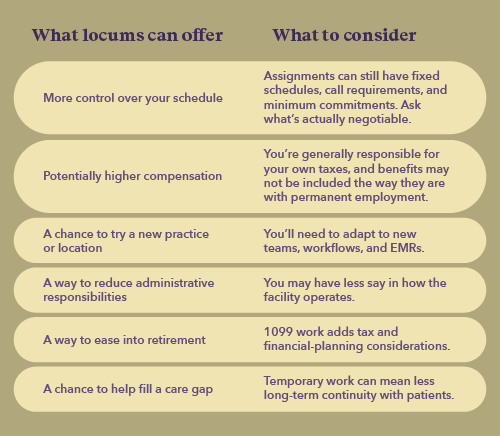
Only you can decide whether the benefits are worth the trade-offs for how you want to practice right now. Find a recruiter you trust, and be upfront about what you’re looking for so they can bring you assignments that actually fit.
The logistics: Malpractice, agencies, and 1099 basics
Understanding the administrative side of locums before you accept an assignment can save you surprises later.
Malpractice coverage
Many locum tenens agencies include malpractice insurance as part of an assignment, but don’t assume every policy works the same way. Ask about:
- Whether the coverage is claims-made or occurrence-based
- Policy limits
- Whether there are exclusions relevant to your practice
- Who’s responsible for tail coverage if the policy is claims-made; this is particularly worth pinning down in oncology, since a patient relationship and treatment plan can continue well after your assignment ends
Dive deeper: How malpractice insurance works for locums
Working with an agency
A locums agency can handle a lot of the logistics behind an assignment: job matching, contracting, travel, housing, licensing, and credentialing support. The facility generally pays the agency, not you. The right agency should understand your specialty, your priorities, and the kind of assignments you actually want.
Not sure where to start? Use our agency comparison tool
Taxes and benefits
Most locum physicians work as independent contractors, so taxes and benefits work differently than they do in a traditional employed role. You may need to arrange your own health insurance and retirement contributions, and plan for estimated taxes. Depending on the assignment and agency, some expenses may be covered or reimbursed, so it’s worth understanding what’s included before you compare pay.
Tax and retirement rules depend on your specific situation. Talk with a qualified tax advisor or financial planner before making decisions about 1099 income, deductions, or retirement contributions.
Taxes for independent contractors: How 1099 taxes work for locum physicians
Getting started: Credentialing, licensing, and finding the right assignment
Once you decide to explore locums, you don’t need everything figured out before you start. A good agency and recruiter can help you work through the process, from finding assignments that fit to handling licensing and credentialing.
Start with the assignment, not the paperwork. Tell your recruiter what matters to you: location, schedule, patient volume, call expectations, inpatient versus outpatient work, and how long you want to be away.
Then dig into the details. Ask about the patient mix, tumor board responsibilities, EMR, support staff, and why the facility needs a locum. Those details shape your day-to-day experience more than the job title does.
Once you’ve found a potential fit, credentialing and licensing come next. Credentialing can take several weeks or longer, so it’s worth starting early. Your agency can help identify what each facility requires and keep the process moving. You’ll need an active medical license in every state where you practice. If you’re eligible, the Interstate Medical Licensure Compact can streamline getting licensed in participating states.
How will it work for you? Locum tenens licensing guide
Travel and housing are usually part of the package, too. Your agency will typically coordinate approved travel and housing, but confirm exactly what’s covered before you accept. If you’re traveling with a spouse, kids, or a pet, bring it up early: policies and added costs vary.
Get the guides: Locum tenens housing and locum tenens travel
FAQs
What should I ask before accepting a medical oncology locum assignment?
At minimum, ask about patient volume and mix, call expectations, inpatient versus outpatient responsibilities, tumor board participation, EMR, support staff, assignment length, malpractice coverage, travel and housing, and why the facility needs locum coverage. Those details tell you far more about an assignment than the job title alone.
For more general locums questions, visit Locumstory’s FAQ hub
How much do medical oncology locums get paid?
Medical oncology is one of the higher-paying locums specialties, though actual rates vary by location, demand, assignment requirements, patient volume, and call. Pay isn’t the whole picture, either: depending on the assignment, travel, housing, and malpractice coverage may also be covered.
For current medical oncology pay ranges, schedules, and assignment data, see the trends by specialty tool
Do I need a new medical license for every locums assignment?
Only for states where you don’t already hold one. Once you’re licensed in a state, you can generally use it for future assignments there as long as it stays active. The Interstate Medical Licensure Compact can streamline licensure if you’re eligible, and a good agency recruiter can walk you through the process.
See the locums licensing guide
Can I work locums part-time while keeping my current job?
Yes. Many physicians use locums as supplemental work rather than replacing their permanent position. Before you commit, check your employment agreement for moonlighting, outside-employment, or non-compete restrictions.
Is there demand for medical oncology locums?
Yes. Oncology is among the specialties with the highest demand for temporary physician coverage, and workforce shortages can make locum coverage important for hospitals and communities recruiting a permanent oncologist. Demand varies by location, subspecialty, and assignment requirements.
Will I have to take call?
It depends on the assignment. Some medical oncology locums positions are outpatient with no call; others include inpatient or weekend coverage. Ask specifically about weekday, overnight, and weekend call before you accept, and whether you’re expected to cover holidays.
Can a locum assignment turn into a permanent job?
Sometimes. A locum assignment gives you and the facility a chance to see how the arrangement works before making a permanent commitment. If you’re open to staying on, tell your recruiter before you accept, so everyone understands your goals.
Will locums work look bad on my CV?
No. Locum tenens is an established part of physician practice today, used both as a primary way to work and alongside permanent positions. According to NALTO, about one in three U.S. physicians has worked a locum tenens assignment at some point in their career. It can also round out your CV with a range of experience and help you get clearer on what you’re looking for long-term.
Does locum work affect Public Service Loan Forgiveness?
It can, depending on your employment arrangement and the organization you work for. Don’t assume locum work will or won’t count toward PSLF. If you’re pursuing forgiveness, verify whether your specific arrangement qualifies before you change how you work, and consider talking with your loan servicer or a financial advisor about your situation.
Who pays for travel and housing for locums?
In many assignments, the agency or facility arranges and covers approved travel and housing, but the details vary. Ask what’s included before you accept, especially if you’re traveling with a spouse, kids, or a pet.
Do locum oncologists get malpractice insurance?
Many locum agencies include malpractice coverage as part of the assignment, but policy terms vary. Ask about coverage limits, whether the policy is claims-made or occurrence-based, and who’s responsible for tail coverage before you accept.
How long do medical oncology locum assignments last?
It varies. Some are short-term coverage; others run several months or get extended. Ask why the facility needs a locum, how long the position has been open, and whether an extension is likely.
You’ve spent years building the clinical judgment to treat people through one of the hardest chapters of their lives. Locum tenens doesn’t ask you to give that up, or to pick one fixed way to practice it for the rest of your career. Work more, or less. Stay close to home, or go somewhere new. The right assignment is the one that matches how you actually want to practice.