
Ben Nanney, CPA, CFP, owner of Locums Tax PLLC, explains how state taxes work for locum tenens physicians. This is not intended as personalized tax advice. Please discuss your specific situation with your tax advisor.
State taxes can be a headache with locum assignments. The good news is that once you understand the basic framework, state taxes are less intimidating and more manageable.
Basics of state taxes for locum physicians
As a locum physician, state taxes are based on two locations:
- Where you live (resident state)
- Where you work (assignment state)
You usually report 1099 assignment income to both your resident and assignment state; first to the assignment state to determine what is owed, then to the resident state.
Your resident state usually won’t tax you twice on the same income. It typically credits you for whatever you already paid the assignment state—often called an ‘Other State Tax Credit’—so that same dollar of 1099 assignment income doesn’t get taxed twice.
Need more locum tenens information for your taxes? Read a physician’s guide to locum tenens taxes
Practical examples for non-resident and resident tax scenarios
Let’s say you’re a physician who lives and owns a home in Chicago, IL, and you work a 6-month 1099 assignment in Prescott, AZ, in 2026. Your business income after expenses is $200,000. For this example, you’re taxed as a sole proprietor—meaning you haven’t set up a separate business entity (like an S corporation), which would change how that income is taxed.
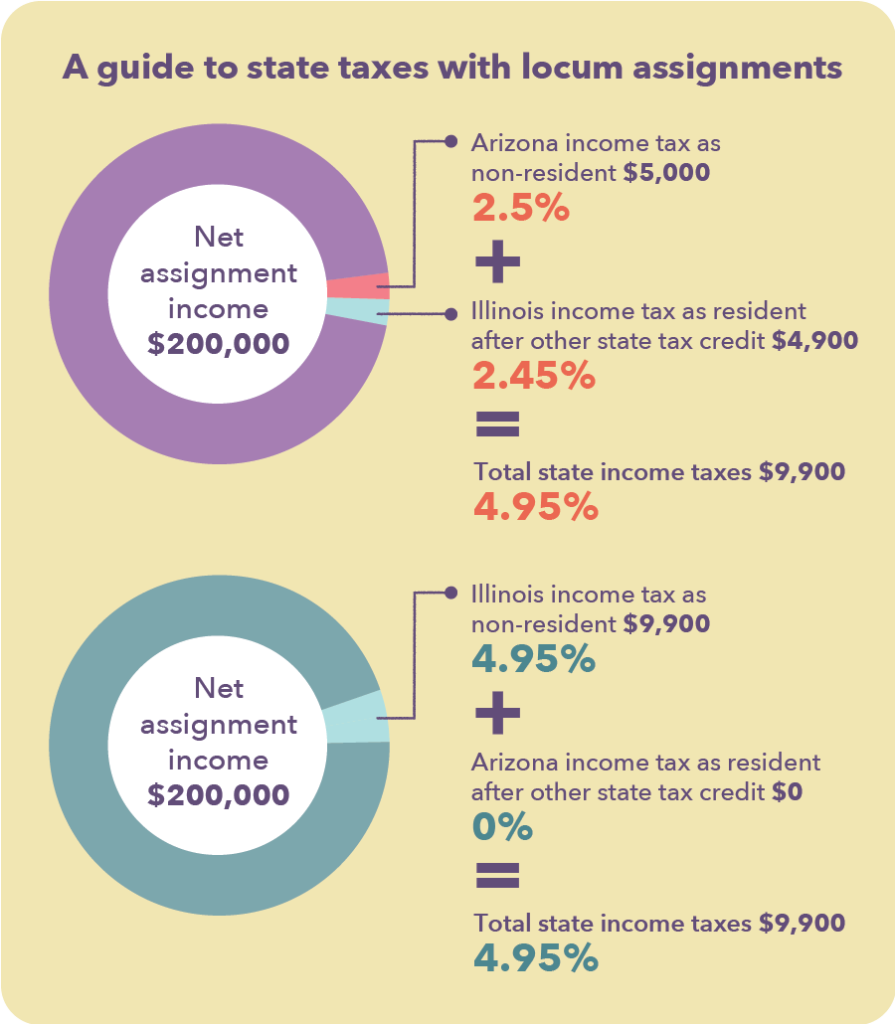
When you file your 2026 individual income tax returns, you’ll first report the $200,000 to Arizona as a non-resident tax filer and owe tax at its 2.5% rate ($5,000). You’ll then report the same $200,000 to Illinois as a resident tax filer. You would initially owe tax at its 4.95% rate ($9,900) for Illinois. Illinois will then reduce the tax owed by the amount you paid Arizona on that same income, leaving a tax owed of $4,900 ($9,900 – $5,000).
This means you’ll pay a total of $9,900 in state taxes ($5,000 for Arizona, $4,900 for Illinois), or 4.95%—which is the higher of the two state rates.
If you instead worked in Chicago, IL, and lived in Prescott, AZ, the $200,000 would first be reported to Illinois as a non-resident tax filer, where you would owe tax at its 4.95% rate ($9,900). You’ll then report the same $200,000 to Arizona as a resident tax filer and initially owe tax at its 2.5% rate ($5,000). Arizona will then reduce the tax owed by the amount you paid Illinois on that same income, leaving a tax owed of $0 ($5,000- 9,900), as it will not be reduced below $0.
This means you’ll again pay a total of $9,900 in state taxes ($9,900 for Illinois, $0 for Arizona), or 4.95%, which is still the higher of the two state rates. In this case, Illinois receives the entire $9,900 payment, but it’s the same out-of-pocket amount for you.
Actual calculations on various state tax returns can be more nuanced than these examples, but the overall principle applies in most situations.
Knowing state individual income tax rates
Since both your resident state and assignment state affect taxes you’ll owe, it’s good to have an awareness of the different state tax rates you can face. These rates can vary from 0% to 10%+, depending on the state and your income.
For a good visual, I like the map at Tax Foundation. You’ll want to verify at the state sites to confirm tax rates reported here, but this is a helpful place to begin, with efforts made to keep information up to date.
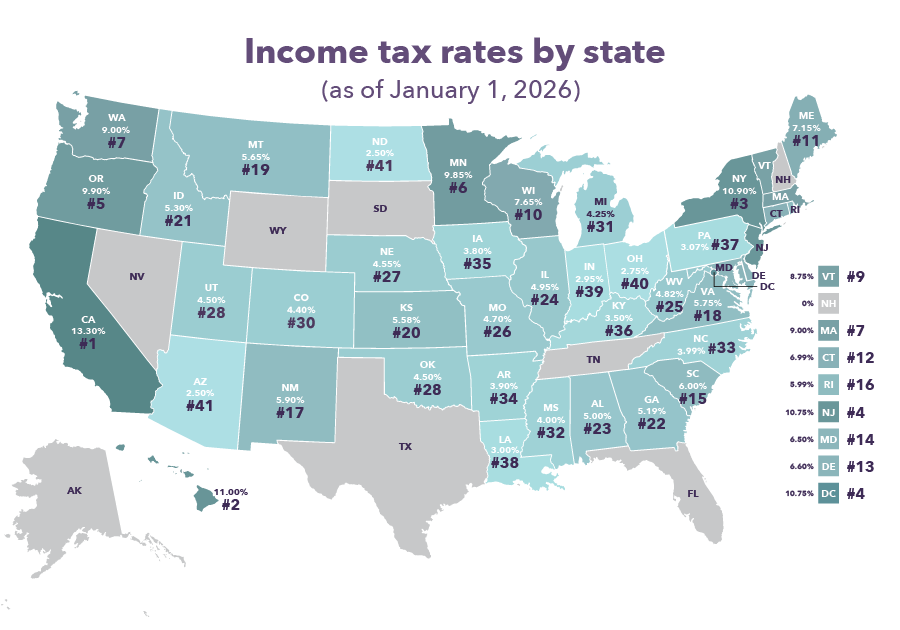
The gray-colored states (e.g., Florida) have no individual income tax. All other states have an individual income tax, with rates ranging from states with flat tax rate of 2.5% (e.g., Arizona) to those with multiple tax rates that top out at 13.3% (e.g., California).
From a state tax perspective, the ideal scenario as a sole proprietor would be to live and work in states with no individual income tax. An example would be living in Texas and working an assignment in South Dakota, neither of which has individual income tax rates.
Working in a low- or no-income tax state will not lower your tax bill if you live in a higher income tax state. This would mean that if you live in California and work an assignment in South Dakota, you’d still report and pay income tax to California as a resident of the state.
Though it is worth considering, I would not make your decisions solely based on state taxes, as there are many other variables that can affect where you live (family ties, climate, schools, etc.) and work assignments (pay rates, patient acuity, expected workload and schedule, etc.).
Earn more: The highest-paying states for locum tenens physicians
Additional tax layers to consider
When you’re working 1099 contracts as a sole proprietor (typically most practical), the individual tax rates of each state usually get the most focus, and for good reason. However, you may owe other taxes that can be easy to miss.
Local income taxes
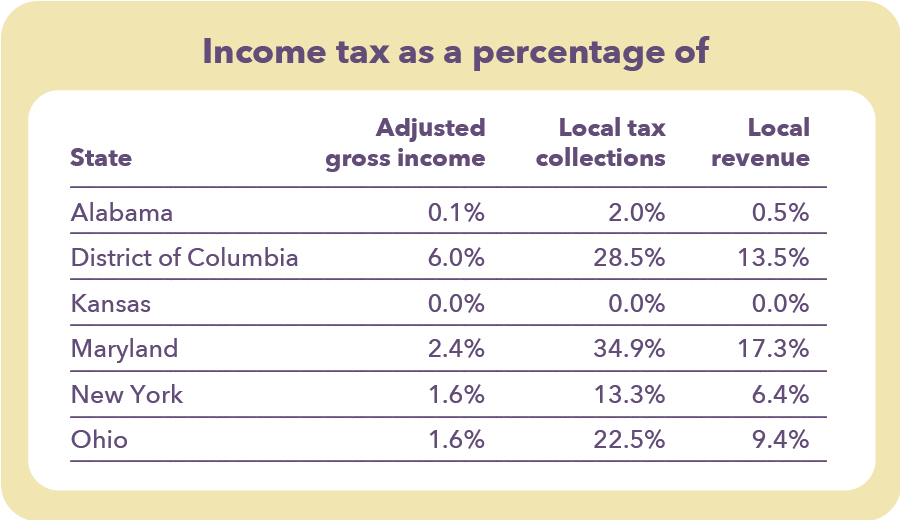
The first are local income taxes. These can have different names, but are basically income tax owed based on the local county or city you’re working in. The following states have more significant local income taxes.
- Indiana
- Kentucky
- Maryland
- Ohio
- Pennsylvania
There are some outlier local income taxes, such as in Portland, OR: this makes working 1099 assignments in Portland one of the highest-taxed in the US when coupled with Oregon-state level taxes that are alone relatively high. Other outliers include Kansas City and St Louis in Missouri and Yonkers and New York City in New York, as neither Missouri nor New York have local income tax in most areas outside these cities.
This table from Tax Foundation provides a solid overview of states with local taxes (though still check yourself for updates):
State-specific exceptions
A few states don’t play by the usual rules. Washington has no individual income tax, but it does have something called the business and occupation tax—a statewide 1.5% flat tax on your gross 1099 assignment income (before expenses come out). Hawaii’s version, the general excise tax, works similarly but at a higher rate—and unlike Washington’s, it comes on top of Hawaii’s regular individual income tax.
Other states may impose a surprise tax if you operate as an s-corporation. For example, Tennessee is an individual income tax-free state. However, its franchise and excise tax applies a 6.5% excise tax to S-corp income (after a $50k deduction). On the other hand, operating as a sole proprietor would subject you to 0% excise tax.
Plan for retirement: Solo 401(k) vs. SEP-IRA for self-employed physicians
How taxes work with telemedicine
Telemedicine may involve treating patients who live in a different state from you. That means you’ll also want to check tax rules based on where your patients are located, not just where you are. Not every state taxes remote telemedicine income this way—and the rules are still evolving—but California, for example, likely would.
As an example, you may be sitting in your home office in Texas remotely serving patients in California. But California will likely expect you to report 1099 income based on those patients as if you were physically serving the patients in California.
Read the guide: Telehealth locum tenens
State tax workarounds that don’t work
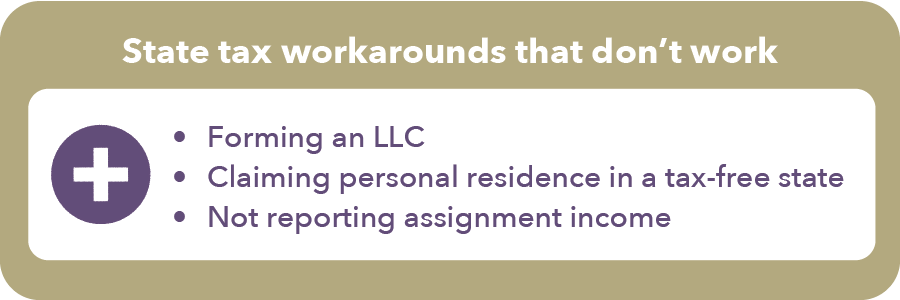
Sometimes, out of an understandable frustration with the different tax laws across states and cities, there can be a search to avoid all the headaches. Below are a few options that sound good on the surface but don’t work in practice.
Forming an LLC
One of these options is forming an LLC in an individual and corporate tax-free state, especially if you already live there, in hopes that having an LLC in a tax-free state prevents any other state or locality from taxing you.
Short answer: this won’t help. It doesn’t matter whether you’re a sole proprietor, an LLC (taxed as either a sole proprietor or an S-corp), or a C-corporation—you owe tax in whatever states and localities you actually do business in, based on their laws, regardless of where you formed the business. No structure shields you from those laws.
Claiming personal residency in a tax-free state
Some people may rent a P.O. Box in Texas or report a family member’s address in Florida to claim residency in a different state. These actions alone do not establish state residency, as states have more formal tests that typically include where you own/rent a home, are registered to vote, have auto registration, spend consistent time in, etc.
If, for example, you live in Connecticut and claim Florida residency, you open yourself up to the liability that Connecticut will conduct a residency audit based on their records (prior residency status, active CT driver’s or medical license, etc.). If you lose, they’ll assess back taxes and penalties for not reporting and paying taxes due to them as a resident of their state.
Not reporting assignment income to the state or locality
A third route is to simply not report assignment income to the assignment state or locality. This is not a legitimate option. If a state or locality did realize you worked there but didn’t report income, they would have the ability to assess both back tax and penalty.
For example, maybe you live in South Dakota and work in Portland, OR. Instead of paying the likely 10%+ additional tax between Oregon and local Portland income tax, you avoid this entirely by not reporting your income on tax returns to Oregon or Portland.
It can be easy to miss a tax filing, especially for local income tax that can be an outlier, but intentionally not reporting income in assignment areas would be considered tax evasion and opens you up to increased liability and headaches every time it happens. Over the course of multiple assignments over multiple years, these create many loose ends.
There are no secret solutions for avoiding state and local tax when you’re working in an area. Ultimately, the most effective advice is to choose to live and work in areas with favorable tax environments when possible, minimize the tax you owe through legitimate options, and pay the tax owed.
Know the tax rules, then get backup
While not the only factor, understanding how state and local taxes work can help when choosing locum assignments, prevent being blindsided by outlier taxes, and avoid chasing tax-saving silver bullets that don’t work in practice.
Because of the potential complexity, it can be worth considering working with a tax accountant, as they can provide guidance and save you time and money if the right fit. When searching for a tax accountant, look for those with experience in multi-state taxation and those willing to explain their positions in a way that makes sense to you. As Ronald Reagan repeated many years ago, “Trust, but verify.”
Just as the right tax accountant makes multi-state filing manageable, finding the locum tenens agency that’s the best fit for you makes it easier to plan assignments with your tax situation in mind from the start.